IndexStyle

A dictionary of design styles, written from the works themselves.

It is plain HTML. It opens on any browser and any device, with no app and no account, and machines read the same page.

Terms776

Dictionary

Search by style name or describe what you are making. Name matches come first; purpose, desired effect and medium add relevant alternatives.

TryBauhausa premium recruiting websitea trustworthy finance app

24/776 shown

577

Glam Rock Fashion — David Bowie’s Ziggy Stardust stage costume, Newcastle, 1972 — photo: Rik Walton — Wikimedia Commons / CC BY-SA 2.0

Glam Rock Fashion

グラムロック・ファッション / 1971–1975 / Style / Fashion History

Early-1970s British rock used glitter, platforms, emphatic makeup, body-fitting clothes and quotations from science fiction and cabaret to turn performers into deliberately artificial stars separated from everyday life.

Glitter, sequins and metallic shine / Platform boots and fitted jumpsuits / Strong eye makeup, colored hair and facial geometry / Science fiction, Hollywood, cabaret and music hall mixed together

design.mdimage prompt

578

Club Kids — Amanda Lepore at Life Ball 2014 — later dress of a Club Kids figure, not an original 1980s club photograph — Manfred Werner - Tsui — Wikimedia Commons / CC BY-SA 3.0

Club Kids

クラブ・キッズ / late 1980s–1990s / Style / Subculture Style

New York nightlife's Club Kids competed in extreme self-transformation rather than finished fashion, assembling body paint, huge hats, toys, scrap and couture into a one-night character whose entrance and photograph were themselves the work.

Full-face paint and prosthetics that turn the wearer into another creature / Head or shoulders expanded beyond bodily scale / Toys, scrap, couture and exposed body deliberately mixed / High chroma, black and white, checks or stripes concentrated into one silhouette

design.mdimage prompt

579

Gorpcore — Contemporary outdoor-inspired outfit, cargo trousers and jacket, 2023 — photo: Kauey — Wikimedia Commons / CC BY-SA 4.0

Gorpcore

ゴープコア / 2017– / Style / Street Style

Gorpcore deliberately restyles technical hiking and camping clothes as urban dress, exposing the function of waterproof shells, fleece, cargo and trail footwear while layering earth tones with safety color into an always-ready-for-the-mountain silhouette.

Functional layering of waterproof shell, fleece and down / Exposed cargo pockets, sealed zips and drawcords / Safety orange or bright accents over forest and earth tones / Trail shoes, backpack and bucket hat

design.mdimage prompt

580

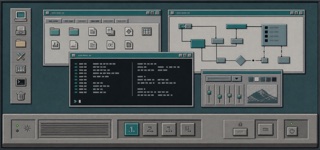
CDE Interface — AI-generated interpretation
AI interpretation, not a reference

CDE Interface

CDEインターフェース / 1993–2000s / Style / Platform Screen Languages

The Common Desktop Environment unified UNIX workstations through Motif-derived bevels, a persistent Front Panel, workspace switching and low-color icons, making different hardware feel like one workplace.

Box-like Front Panel along the lower edge / Raised buttons and recessed fields made from paired light and dark borders / Low-color pixel icons with dark outlines / Persistent buttons for switching among workspaces

design.mdimage prompt

581

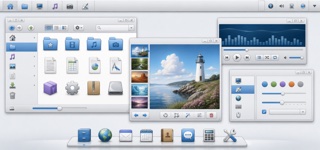
KDE Oxygen — AI-generated interpretation
AI interpretation, not a reference

KDE Oxygen

KDE Oxygen / 2006–2014 / Style / Platform Screen Languages

Oxygen unified KDE 4 applications, workspace and icons through clear blue, soft gray, fine outlines and icons that seem to rest on a shared shelf, bringing lightness to an information-dense desktop.

Pale-gray chrome with blue selection and restrained gloss / Dimensional icons with one-pixel edges and a lower shelf shadow / One upper-diagonal light source across materials / Toolbars and docks grouped by fine separators

design.mdimage prompt

582

GNOME Clearlooks — Clearlooks 2.20, Nautilus and gedit interface — screenshot: KiddoKiddo (historical software example) — Wikimedia Commons / CC0

GNOME Clearlooks

GNOME Clearlooks / 2005–2011 / Style / Platform Screen Languages

GNOME 2.12's standard theme made GTK applications friendly and simple through pale-gray windows, blue selection, restrained gloss and firm boundaries.

Pale-gray surfaces with blue selection bars / A quiet highlight only along button tops / Tabs and fields with restrained rounding / Small GNOME icons and a concise two-level hierarchy

design.mdimage prompt

583

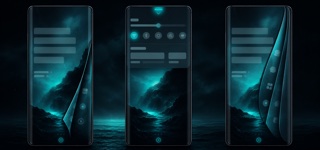
Sailfish Silica — AI-generated interpretation
AI interpretation, not a reference

Sailfish Silica

Sailfish Silica / 2013– / Style / Platform Screen Languages

Sailfish OS's QML language centers the mobile experience on edge gestures and Ambience: wallpaper color runs through translucent type and highlights, while the screen edge itself becomes back, close and switch.

Text and focus tinted from the wallpaper / Translucent controls floating over dark imagery / Layers peeled by swipes from screen edges / Pulley Menu revealed by pulling, with generous spacing

design.mdimage prompt

584

Halftone — Black halftone simulation — بهرام عفراوی — Wikimedia Commons / CC BY-SA 3.0

Halftone

ハーフトーン(網点) / 1880s– / Technique / Print Expression

Halftone converts continuous tone into regularly spaced dots of changing size so it can be printed; from a distance they return to tone, while enlargement reveals the screen as material.

Large and small dots on one fixed pitch / Light and shade made by dot area / Rosettes from differently angled color screens / An image that changes between normal and magnified viewing

design.mdimage prompt

585

Dithering — Ordered dithering with a 4×4 Bayer matrix, two-colour technical example — Joachim Holmér — Wikimedia Commons / CC BY-SA 4.0

Dithering

ディザリング / 1960s– / Technique / Digital Image Techniques

Dithering suggests unavailable intermediate colors by spatially mixing pixels from a limited palette; ordered matrices or error diffusion make both tone and a distinctive granular surface.

Two or more pixel colors mixed as checks or grain / High-frequency dots spreading around tonal boundaries / Apparent gradients made from a fixed palette / A pattern up close that becomes an intermediate color at normal distance

design.mdimage prompt

586

Fractal Flame — Fractal flame, Genesis cells, generated with FLAM3 for SideFX Houdini and rendered with Mantra — Alexnardini — Wikimedia Commons / CC BY-SA 4.0

Fractal Flame

フラクタル・フレーム / 1992– / Technique / Computational Expression

Scott Draves's Fractal Flame adds nonlinear variations, log-density display and structural coloring to iterated function systems, producing feathered, smoky and coral-like structures from probability and transformation history.

Translucent branching like flame or feathers / Bright high-density regions emerging from darkness / Self-similar detail continuing under magnification / Smooth color driven by transformation history

design.mdimage prompt

587

Cel Shading — Cel-shaded probability-density isosurfaces from a particle-in-a-box simulation — Kri — Wikimedia Commons / CC BY-SA 3.0

Cel Shading

セルシェーディング / 1990s– / Technique / Digital Image Techniques

Cel shading quantizes continuous 3D lighting into a few flat bands and may add contours, retaining spatial movement while making the surface read like animation cels or printed illustration.

Shadow split into two or three flat values / Strong outer and crease contours / Uniform color planes with restrained reflections / Three-dimensional motion beneath a drawn surface

design.mdimage prompt

588

Databending — green.qt_slippage, exhibited digital glitch work — jonCates — Wikimedia Commons / CC BY-SA 4.0

Databending

データベンディング / 2000s– / Technique / Digital Image Techniques

Databending edits image or sound files with tools not intended for their format, turning a decoder's misreading into the work; file structure, compression and edit position determine its bands and color shifts.

Sections of an image displaced into horizontal bands / Separated color channels and unexpected saturation / Local compression blocks that leave the source visible / Row-like fractures repeating from the edit point

design.mdimage prompt

589

L-system Graphics — First six iterations of an L-system fractal tree — NightElfik — Wikimedia Commons / Public domain

L-system Graphics

L-systemグラフィックス / 1968– / Technique / Computational Expression

L-system graphics rewrite symbol strings in parallel and interpret them as drawing, turning a few rules into recursively growing plants, trees, mycelia and ornaments.

Branches repeating one angle rule from a trunk / Self-similar detail increasing by generation / Leaves or flowers attached regularly at tips and joints / A growth grammar that survives controlled randomness

design.mdimage prompt

590

Reaction–Diffusion — Turing patterns from numerical simulation — published reaction-diffusion output by Ex.ungue.leonem, 2008 — Wikimedia Commons / Public domain

Reaction–Diffusion

反応拡散パターン / 1952– / Technique / Computational Expression

Reaction-diffusion simulation lets substances react locally while spreading at different rates, self-organizing small disturbances into spots, stripes, mazes and coral-like patterns.

Round spots dividing at even distances / Continuous curving maze stripes / Coral or cellular boundaries branching from edges / Self-organized marks of nearly constant thickness

design.mdimage prompt

591

Stippling — Stippled scientific line drawing of Auranticordis quadriverberis — Chitchai Chantangsi, Heather J. Esson and Brian S. Leander — Chitchai Chantangsi, Heather J Esson and Brian S Leander — Wikimedia Commons / CC BY 2.0

Stippling

スティップリング(点描陰影) / 16th century– / Technique / Hand-drawn

Stippling builds light, volume and surface through the density and size of tiny dots; tone rises from sparse to dense without filling contours with lines.

Countless small dots filling a contour / Narrower spacing in darker areas / Soft tone without hatched lines / Grain up close and smooth volume at distance

design.mdimage prompt

592

Scratchboard — Jane S. Richardson, hand-drawn ribonuclease S ribbon diagram on scratchboard — image: Dcrjsr — Wikimedia Commons / CC BY 3.0

Scratchboard

スクラッチボード / 19th century– / Technique / Hand-drawn

Scratchboard removes black ink from a white clay-coated board, drawing light and contour out of darkness; blade width, crossing and retained black create fur, metal and nocturnal contrast.

Sharp white lines cut from a black ground / Contour and highlight joined by the same blade marks / Crossed lines and dots producing middle values / Broad retained black with concentrated white detail

design.mdimage prompt

593

Visual Kei — Visual-kei cosplay at Jingūbashi, Tokyo, 2006 — photo: Jacob Ehnmark — Wikimedia Commons / CC BY 2.0 · © Jacob Ehnmark from Tokyo, Japan

Visual Kei

ヴィジュアル系 / 1980s– / Style / Subculture Style

Visual Kei is a Japanese rock and metal visual culture in which hair, makeup, costume, stage and photography construct a band persona as strongly as the music, crossing glam, gothic, punk, Kabuki and historic dress.

Large gravity-defying hair built from sharp sections / Theatrical pale makeup, strong eyes and fine brows / Leather or lace mixed with jewelry, military and historic dress / Long silhouettes crossing gender markers

design.mdimage prompt

594

Grunge Fashion — Contemporary flat-lay example of flannel shirt and ripped jeans — Anettemgonzalez (reconstruction of 1990s dress) — Wikimedia Commons / CC BY-SA 4.0

Grunge Fashion

グランジ・ファッション / late 1980s–1990s / Style / Subculture Style

Grunge fashion grew from mismatched, layered secondhand and work clothing in the Pacific Northwest music scene before its early-1990s runway translation; flannel, worn knits, boots and displaced hems became an answer to polished luxury.

Oversized checked flannel worn open in layers / Pilled knit, thrifted dress and distressed denim mixed / Heavy work boots and off-body sizing / Muddy earth tones and washed black layered together

design.mdimage prompt

595

Beatnik Style — Beatnik coffeehouse costumes in A Bucket of Blood, 1959 — cinematic depiction, not a documentary street photograph — American International Pictures — Wikimedia Commons / Public domain

Beatnik Style

ビートニク・スタイル / 1950s–early 1960s / Style / Subculture Style

The image of Beat and Left Bank culture settled into black turtlenecks, narrow trousers, berets, flats and spare makeup, making an anti-consumer intellectual space of readings, jazz and cafés visible on the body.

Black turtleneck or oversized borrowed sweater / Narrow black trousers and flat shoes / Beret, short hair and minimal jewelry / A long silhouette limited to black, charcoal and natural cloth

design.mdimage prompt

596

Western Wear — Lefty Frizzell in an embroidered Western shirt — Columbia Records promotional portrait, 1957 — Wikimedia Commons / Public domain

Western Wear

ウェスタン・ウェア / 19th century– / Style / Fashion History

Western wear developed from ranch and riding utility into rodeo, film and country stage dress, adding embroidery, fringe, studs and emphatic color to functional yokes, snaps, boots and hats.

Pointed western yokes dividing chest and back / Curved-brim hat and high-shaft boots / Pearl-like snaps and contrast piping / Symmetric embroidery, fringe and studs

design.mdimage prompt

597

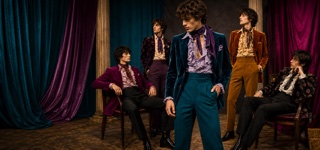
Peacock Revolution — AI-generated interpretation
AI interpretation, not a reference

Peacock Revolution

ピーコック・レボリューション / mid-1960s–early 1970s / Style / Fashion History

The Peacock Revolution released postwar menswear from the dark suit, spreading close tailoring, vivid color, velvet, frills and flowers into young men's street and stage dress while modern dandyism unsettled gender and class rules.

Close-fitting jackets and high waists / Bold velvet, satin, floral print and vivid color / Frilled shirts, scarves, wide collars and cuffs / Long hair and heels within a delicate decorated male silhouette

design.mdimage prompt

598

Biker Style — Leather biker jacket and riding trousers, contemporary motorcycle-rally photograph — Phoenician Patriot — Wikimedia Commons / CC BY-SA 3.0

Biker Style

バイカー・スタイル / 1920s– / Style / Subculture Style

A protective riding jacket became a language of rebellion and belonging through motorcycle clubs, film, rock and punk; asymmetrical zip, wide lapels, belt, hardware and worn black leather retain both function and symbol.

Asymmetric zipper crossing the front / Hard outline from wide lapels, epaulettes and waist belt / Heavy black leather and silver hardware / Back patches, studs, wear and personal marks

design.mdimage prompt

599

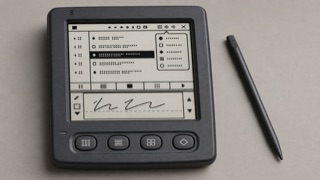
Palm OS Interface — AI-generated interpretation
AI interpretation, not a reference

Palm OS Interface

Palm OSインターフェース / 1996–2009 / Style / Platform Screen Languages

Palm OS turned a tiny monochrome screen, stylus and strict memory limits into a consistent pocket work tool through the Title, Category menu, Command Bar, hardware buttons and Graffiti writing area.

A roughly 160 by 160 low-resolution monochrome screen / Title at upper left and Category pop-up at upper right / A Command Bar rising from the lower edge and four application buttons / Thin one-bit icons, rules and the Graffiti input area

design.mdimage prompt

600

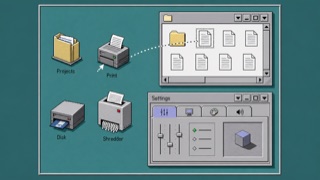
OS/2 Workplace Shell — AI-generated interpretation
AI interpretation, not a reference

OS/2 Workplace Shell

OS/2 Workplace Shell / 1992–2001 / Style / Platform Screen Languages

OS/2 treated folders, printers, drives and settings as operable objects rather than loose icons. Dimensional borders, shaded icons, Notebook settings and direct drag-and-drop made the whole desktop one object-oriented workplace.

Pale gray surfaces with double light and dark dimensional edges / Low-color object icons drawn from an oblique view / Notebook settings with stacked edge tabs / Direct dragging among folders, shredder and drives

design.mdimage prompt

Editorial policy

IndexStyle is not a list of every term used around design. An independent entry must describe a visual language that can be recognised, reproduced and distinguished from its neighbours. Editorial standard

Back to top