2

Bauhaus
バウハウス / 1919–1933 / Style / Functionalism
Why it is closeName matchText match
Makes function and play coexist through the circle, triangle and square.
Elementary shapes / Primary colors / Functional beauty / Visible structure
A dictionary of design styles, written from the works themselves.
It is plain HTML. It opens on any browser and any device, with no app and no account, and machines read the same page.
| Terms | 776 |
|---|
Search by style name or describe what you are making. Name matches come first; purpose, desired effect and medium add relevant alternatives.
TryBauhausa premium recruiting websitea trustworthy finance app
Searching names, descriptions and practical uses
2
バウハウス / 1919–1933 / Style / Functionalism
Why it is closeName matchText match
Makes function and play coexist through the circle, triangle and square.
Elementary shapes / Primary colors / Functional beauty / Visible structure
244

バウハウスの舞台 / 1921–1929 / Style / Stage Design
Why it is closeName matchText match
Schlemmer's stage workshop turned the body into geometry. Spheres and cones in the Triadic Ballet costumes set the human figure dancing as a form in space, and performance art traces its origin to them.
Geometrized bodies / Costumes of spheres and cones / Three acts by color / Choreography as spatial figure
6

モダニズム / 1920s–1970s / Style / Functionalism
Why it is closeText match
Replaces ornament with reasoned form and aims at universality. The particular answers stand as their own entries, and Bauhaus, Swiss, Minimalism and Streamline Moderne are all separate solutions arrived at from this one stance.
Simplification / Clear hierarchy / Function first / Universal forms
225

ウルム造形大学 / 1953–1968 / Style / Postwar Industrial Design
Why it is closeText match
Founded by Max Bill as the Bauhaus's successor, the school redefined design as science, method and system. Its collaboration with Braun made the functionalist face a world standard.
Method and system / Grids and modules / Ornament excluded / Design as science
654
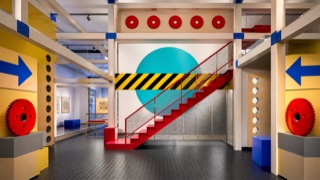
ファクトリー・ポモ / late 1980s–early 1990s / Style / Industrial and Spatial Design
Why it is closeText match
A brief late-1980s and early-1990s postmodern style that reassembled factory safety graphics, WPA, Constructivism, and Bauhaus through smooth CAD geometry and Memphis quotation. Industrial signs become bright information-age stage sets rather than preserved relics.
Gears, bolts, beams, and arrows reduced to geometry / Black and safety yellow expanded with red, blue, and turquoise / CAD-perfect circles and diagonals over old factory lettering / Exposed structure converted into decorative repetition
666
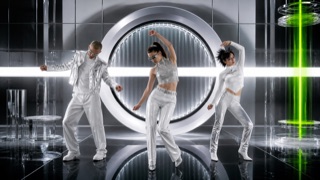
ミレニアム・ディスコ / late 1990s–early 2000s / Style / Music Graphics
Why it is closeText match
A turn-of-the-millennium Gen-X revival that recasts 1970s disco through Bauhaus-derived type, silver technical materials, and smooth photography. Whiter and more metallic than Disco Deco, it presents the dancing body like a new digital product.
White, silver, and black with one acid green or orange accent / Bauhaus-like circles, concentric lines, and horizontal bars / Clean reflections on chrome, translucent resin, and metallic cloth / Dancing bodies shot with wide flash and long trails
IndexStyle is not a list of every term used around design. An independent entry must describe a visual language that can be recognised, reproduced and distinguished from its neighbours. Editorial standard