IndexStyle

A dictionary of design styles, written from the works themselves.

It is plain HTML. It opens on any browser and any device, with no app and no account, and machines read the same page.

Terms776

Dictionary

Search by style name or describe what you are making. Name matches come first; purpose, desired effect and medium add relevant alternatives.

TryBauhausa premium recruiting websitea trustworthy finance app

24/776 shown

673

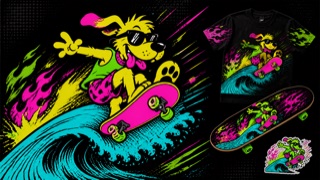
Rad Dog / Neon Surf — AI-generated interpretation
AI interpretation, not a reference

Rad Dog / Neon Surf

ラッド・ドッグ/ネオン・サーフ / late 1980s–early 1990s / Style / Subculture Style

A late-1980s and early-1990s surf, skate, youth-apparel, and equipment style gathering fluorescent splatter, cartoon animals, waves, distorted type, and extreme Hypercolor. It prioritizes speed, mischief, and shelf visibility over natural ocean color.

Fluorescent pink, lime, and cyan splatter on black or white / Cartoon animals, waves, boards, teeth, and flames / Heavy slanted lettering with multiple outline, shadow, and scratch layers / One mascot repeated across shirts, boards, stickers, and equipment

design.mdimage prompt

674

Renaissance Revival — Neo-Renaissance buildings, Oranjesingel 2–8, Nijmegen — photo: Roger Veringmeier — Wikimedia Commons / CC BY 3.0

Renaissance Revival

1990年代ルネサンス・リバイバル / early–late 1990s / Style / Historical Styles

A 1990s revival in which Renaissance fairs, Shakespeare editions, fantasy films, runway styling, and formalwear restaged Renaissance, Elizabethan, medieval, and fairy-tale references with deliberate anachronism. It creates a rich past that present-day visitors can enter rather than reconstructing history faithfully.

Deep green, wine, antique gold, and violet across velvet and brocade / Corsets, long sleeves, capes, and rich weaving mixed with modern silhouettes / Stone arches, vines, heraldry, fairies, and old books as stage props / Decorative serif, blackletter-like headings, and selective manuscript initials

design.mdimage prompt

675

Action Painting — Action-painting example — Gmhofmann (contemporary example, not a historical Pollock work) — Wikimedia Commons / CC BY-SA 3.0

Action Painting

アクション・ペインティング / late 1940s–1960s / Style / Postwar American Art

An abstract-painting style that treats the surface as a record of the body's passage rather than a container for a predetermined image. Drips, throws, scrapes, broad strokes, and repainting preserve speed, weight, pause, and sequence.

Drips, splashes, and runs retaining gravity / Long strokes that reveal the reach of an arm or body / Layers, scraping, and repainting left visible / Density and open intervals distributed without a central figure

design.mdimage prompt

676

Concrete Art — Theo van Doesburg, Arithmetic Composition, 1930 — Wikimedia Commons / Public domain

Concrete Art

コンクリート・アート / 1930s–1960s / Style / Geometric Abstraction

A movement constructing autonomous compositions only from line, plane, color, and proportion rather than abstracting nature or narrative. It suppresses chance and brushwork in favor of measurable relations and clear color fields across painting, print, object, and graphic design.

Circles, rectangles, and lines placed by measurable ratios / Hard color boundaries without expressive brushwork / Flat relations without perspective or natural outlines / Variation produced from a small palette and repeated unit

design.mdimage prompt

677

Der Blaue Reiter — Franz Marc, Blue Horse I, 1911 — Lenbachhaus, Munich / Google Art Project — Wikimedia Commons / Public domain

Der Blaue Reiter

青騎士 / 1911–1914 / Style / Avant-garde

The Munich-based Expressionist group that prioritized the spiritual resonance of color and form over natural description. Strong blue, yellow, and red, animals and riders, musical repetition, and color released from contour bridge figuration and abstraction.

Blue, yellow, and red detached from natural color / Horses, riders, mountains, and villages simplified into curves and fields / Color fields slipping away from contour / Musical repetition and rising diagonals moving the surface

design.mdimage prompt

678

Die Brücke — Ernst Ludwig Kirchner, Die Brücke exhibition poster, Galerie Arnold, Dresden, 1910 — Wikimedia Commons / Public domain

Die Brücke

ブリュッケ / 1905–1913 / Style / Avant-garde

The Dresden group that compressed the city, nude figure, nature, and nightlife into sharp contour, rough woodcut, and non-natural color. Unlike the Blue Rider's spiritual abstraction, it foregrounds the urgent material contact of bodies, streets, and collective making.

Angular heavy contours and flat non-natural color / Black-and-white cuts retaining the resistance of wood / Elongated urban figures and nudes / Red, orange, green, and violet creating unstable space

design.mdimage prompt

679

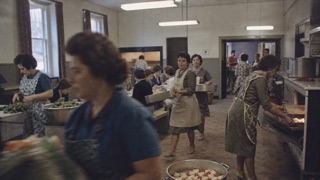
Direct Cinema — AI-generated interpretation
AI interpretation, not a reference

Direct Cinema

ダイレクト・シネマ / late 1950s–1970s / Style / Cinematic Visual Styles

A documentary-film style using lightweight cameras, synchronous sound, and small crews to follow events with minimal intervention. It restrains explanatory narration, reenactment, and excessive lighting so handheld distance, location sound, and observation reveal relationships.

Small handheld movement and in-the-moment framing / Location sound with restrained narration and music / People observed in action rather than seated in interview sets / Longer shots preserving before and after, with uneven exposure

design.mdimage prompt

680

Geometric Abstraction — Sophie Taeuber-Arp, Animated Circle Figure, 1934 — Kunstmuseum Basel; reproduction: Paradise Chronicle — Wikimedia Commons / Public domain

Geometric Abstraction

幾何学的抽象 / 1910s–present / Style / Geometric Abstraction

An abstract style composing with circles, rectangles, lines, grids, repetition, and proportion instead of depicting natural objects. It is an umbrella across De Stijl, Suprematism, Concrete Art, and Hard-Edge, united by geometry and clear boundaries rather than gesture.

Circles, rectangles, lines, and grids as primary forms / Clear boundaries and surface relations over illusionistic depth / Ratio, repetition, rotation, and displacement as rules / Focus produced by relations of color and form without a figurative protagonist

design.mdimage prompt

681

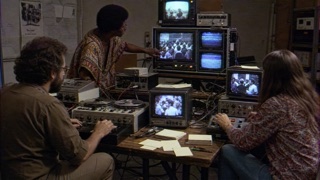
Guerrilla Television — AI-generated interpretation
AI interpretation, not a reference

Guerrilla Television

ゲリラ・テレビジョン / late 1960s–1980s / Style / Experimental Film

A media movement in which small collectives used portable video to oppose broadcast authority and one-way communication, recording demonstrations, communities, and institutions for rapid editing and alternative circulation. Low resolution, handheld access, feedback, direct titles, and multiple viewpoints became its language.

Low-resolution portable video, trails, clipping, and dropouts / Long handheld records embedded in events / Handwritten cards, coarse electronic type, and direct time or place labels / Split screens, feedback, and reshooting that dismantle broadcast images

design.mdimage prompt

682

Mail Art — Honys Torres, Dollar Lechuga, 2012 — mail-art work published by the artist — HonysTorresArt — Wikimedia Commons / CC BY-SA 4.0

Mail Art

メール・アート/郵便芸術 / 1960s–present / Style / Avant-garde

A network art practice that treats envelopes, postcards, stamps, rubber stamps, addresses, postmarks, and delivery time as compositional parts. The work is a system for reply, forwarding, addition, and arrival rather than one finished sheet.

Envelopes, postcards, address fields, and postal frames structuring the page / Artistamps, rubber stamps, typing, and photocopy layered together / Folds, abrasion, postmarks, and dates from transit retained / Instructions or space for a recipient to reply, alter, or forward

design.mdimage prompt

683

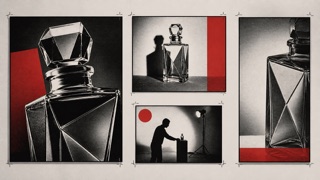
Pictures Generation — AI-generated interpretation
AI interpretation, not a reference

Pictures Generation

ピクチャーズ・ジェネレーション / late 1970s–1980s / Style / Postwar American Art

A late-1970s and 1980s tendency that displaced already familiar advertising, film, magazine, and television images through rephotography, performance, cropping, and overlaid text, exposing systems of authorship, desire, gender, and consumption.

Rephotographed or reenacted images with advertising or film familiarity / Aggressive cropping that removes source context / Short declarative copy over monochrome or limited-color photography / Repeated figures, poses, or commodities whose differences emerge as a series

design.mdimage prompt

684

Return to Order — Georg Schrimpf, Staffelsee, 1934 — Wikimedia Commons / Public domain

Return to Order

秩序への回帰 / 1918–1930s / Style / Figurative Painting

An international post-World War I tendency that stepped back from avant-garde fragmentation and speed toward classical contour, stable figures, still life, and legible space. It retained modern simplification while recovering weight and order rather than reconstructing the past literally.

Large stable figures and still lifes with clear contour / Triangles, horizontals, and frontal balance / Restrained earth, blue, and lime-gray fields / Avant-garde simplification retained while fragments return to bodies and objects

design.mdimage prompt

685

Akwete — Akwete weaving on a vertical loom, Nigeria, 2017 — photo: OBankz (Ekekeh Ubadire Obioma) — Wikimedia Commons / CC BY-SA 4.0

Akwete

アクウェテ織 / late 19th century–present / Style / Textile Traditions

A textile developed by Igbo women in Akwete, southeastern Nigeria. Broad upright looms and supplementary weft build named chevrons, diamonds, animals, and apparent bands into dense fields of vivid color and occasional metallic thread.

Heavy vertical and horizontal bands dividing the field / Supplementary-weft floats drawing chevrons, diamonds, and animals / Narrow shifts among saturated purple, orange, green, red, and black / Internal repeats and boundary lines making one broad cloth resemble joined strips

design.mdimage prompt

686

Crinoline Silhouette — American or European crinoline — Metropolitan Museum of Art, CI37.46.54 — Wikimedia Commons / CC0

Crinoline Silhouette

クリノリン・シルエット / mid-1850s–late 1860s / Style / Fashion History

A mid-nineteenth-century silhouette system that joins concentric steel hoops with tapes beneath a skirt, spreading the whole circumference into a bell or dome. The mass-produced structure replaced layers of heavy petticoats and changed both the dress outline and the space a wearer occupied.

Bell or dome expanding evenly from waist to hem / Regular tension from horizontal concentric hoops beneath the cloth / A small fitted torso contrasted with a large circular base / Tiered trim, flounces, or broad motifs repeating around the hem

design.mdimage prompt

687

Bustle Silhouette — American child's dress with bustle silhouette, ca. 1885, side view — Metropolitan Museum of Art, 62.97.5a–c — Wikimedia Commons / CC0

Bustle Silhouette

バッスル・シルエット / late 1860s–mid-1880s / Style / Fashion History

A late-nineteenth-century silhouette system concentrating pads, horsehair, cages, springs, skirt volume, and trim behind the waist. Front and sides stay comparatively narrow while projection, drape, and train are staged at the back.

Rounded or horizontal projection immediately behind the waist / A comparatively flat front with cloth and trim gathered behind / Overskirt, pleats, drapery, and train flowing front to back / An elongated fitted torso contrasted with an asymmetrical side profile

design.mdimage prompt

688

Pannier Silhouette — Hoop petticoat and corset, England, 1750–80 — Los Angeles County Museum of Art; photo: Marshall Astor — Wikimedia Commons / CC BY-SA 2.0 · © Marshall Astor - Food Fetishist

Pannier Silhouette

パニエ・シルエット / late 17th–late 18th century / Style / Fashion History

An eighteenth-century silhouette system suspending basket-like supports at both hips so width grows laterally while front and back remain flat. Court dress and the robe à la française used this horizontal field to display woven pattern, trim, and frontal gesture.

A wide lateral outline with shallow front-to-back depth / A nearly horizontal upper edge extending from both hips / A central stomacher and open skirt aligned on the frontal axis / Woven silk, ribbons, and lace displayed symmetrically across the width

design.mdimage prompt

689

Spanish Farthingale Silhouette — Elizabeth I, 16th-century portrait, attributed to George Gower (formerly attributed to Steven van der Meulen) — historical dress example — Wikimedia Commons / Public domain

Spanish Farthingale Silhouette

スパニッシュ・ファージンゲール / late 15th–early 17th century / Style / Fashion History

A Spanish court-dress silhouette formed by hoops increasing toward the floor, fixing the skirt into a rigid cone or triangle from waist to hem. It suppresses folds and joins an upright torso, narrow waist, and broad base into one geometry.

A cone or triangle opening in straight lines from waist to floor / Horizontal hoops increasing downward while suppressing surface folds / High collar or ruff, rigid torso, and long verticals / Black or deep color, gold thread, and jewels organized symmetrically

design.mdimage prompt

690

Robe à la Française — Woman’s robe à la française, England, ca. 1765 — Los Angeles County Museum of Art — Wikimedia Commons / Public domain

Robe à la Française

ローブ・ア・ラ・フランセーズ / 1730s–1770s / Style / Fashion History

An eighteenth-century gown style combining a fitted front, triangular stomacher, open overskirt, and two deep box pleats falling unbroken from shoulders to floor. Pannier width and silk surface separate frontal decoration from the long flow of the back.

Two deep box pleats running continuously from upper back to hem / A triangular stomacher and laddered ribbons filling the center front / An open overskirt revealing a decorated petticoat / Elbow-length sleeves ending in layered lace engageantes

design.mdimage prompt

691

Slashing — Albrecht Dürer, Lady on Horseback and Lansquenet — Rijksmuseum, RP-P-OB-1247; historical slashed dress example — Wikimedia Commons / CC0

Slashing

スラッシング装飾 / late 15th–17th century / revivals / Technique / Fashion History

A decorative technique making regular cuts through an outer layer of clothing, hats, or shoes to reveal lining, undercloth, or pulled fabric beneath. Cut shape, spacing, direction, and contrasting color turn the surface into a controlled two-layer rhythm rather than random damage.

Evenly spaced straight, wavy, or crossed cuts through the outer layer / Contrasting lining or puffed undercloth visible through each opening / Cut density and size changing with sleeve, torso, or shoe form / Embroidery, pinking, or paning may join it, but the repeated opening remains primary

design.mdimage prompt

692

Ashcan School — George Bellows, Cliff Dwellers, 1913 — Los Angeles County Museum of Art — Wikimedia Commons / Public domain

Ashcan School

アシュカン・スクール / c. 1900–1915 / Style / Figurative Painting

An early-twentieth-century New York urban realism that raised crowded streets, saloons, theaters, and working neighborhoods into major subjects through the speed of newspaper illustration and a dark, rough paint surface.

Crowded street and interior groups / Dark brown, soot black, and muted red / Fast broad marks and reportorial cropping / Workers, immigrants, and entertainment districts without idealization

design.mdimage prompt

693

Hudson River School — Thomas Cole, The Oxbow, 1836 — Metropolitan Museum of Art — Wikimedia Commons / CC0

Hudson River School

ハドソン・リヴァー派 / 1820s–1870s / Style / Landscape Painting

A nineteenth-century American landscape language that joined mountains, rivers, and forests to national grandeur, spirituality, and expansion through immense distance, precise detail, and theatrical light.

Vast distance framed by dark trees or rock / Golden light breaking onto a valley or water / Tiny people or buildings against immense nature / Precise vegetation, geology, and atmospheric depth

design.mdimage prompt

694

Barbizon School — Théodore Rousseau, The Edge of the Woods at Monts-Girard, Fontainebleau Forest, 1852–54 — Metropolitan Museum of Art — Wikimedia Commons / CC0

Barbizon School

バルビゾン派 / 1830s–1870s / Style / Landscape Painting

French landscape painting built from direct observation around Fontainebleau, treating trees, marsh, fields, livestock, weather, and labor as the subject rather than the background to a historical story.

Low horizon under a changing sky / Trees, marsh, livestock, and rural labor / Restrained brown, green, and grey earth colors / The directness of outdoor studies joined to substantial studio paint

design.mdimage prompt

695

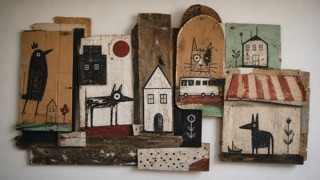
Mission School — AI-generated interpretation
AI interpretation, not a reference

Mission School

ミッション・スクール / 1990s–early 2000s / Style / Street Style

A 1990s San Francisco DIY art language that mixed storefront signs, skating, comics, folk art, urban scrap, small drawings, and handmade installations to record life and change around the Mission District.

Work on cardboard, scrap wood, and reused signs / Comic figures and dense hand lettering / Worn local color led by brown, black, and red / Improvised displays linking skating, shops, and street life

design.mdimage prompt

696

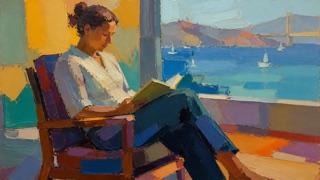
Bay Area Figurative Movement — AI-generated interpretation
AI interpretation, not a reference

Bay Area Figurative Movement

ベイエリア・フィギュラティヴ / 1950s–1960s / Style / Figurative Painting

Bay Area painting that returned to figures, rooms, cities, and landscapes without abandoning Abstract Expressionism's broad marks and thick color fields; figure and ground carry the same painterly pressure.

Figures built from broad flat strokes / Contours dissolving into surrounding color / Opaque complementary color / Everyday interiors, beaches, and streets simplified into large forms

design.mdimage prompt

Editorial policy

IndexStyle is not a list of every term used around design. An independent entry must describe a visual language that can be recognised, reproduced and distinguished from its neighbours. Editorial standard

Back to top