IndexStyle

A dictionary of design styles, written from the works themselves.

It is plain HTML. It opens on any browser and any device, with no app and no account, and machines read the same page.

Terms776

Dictionary

Search by style name or describe what you are making. Name matches come first; purpose, desired effect and medium add relevant alternatives.

TryBauhausa premium recruiting websitea trustworthy finance app

24/776 shown

457

Novecento Italiano — Mario Sironi, Composition with Figures — Fondazione Cariplo / CC BY-SA 3.0

Novecento Italiano

ノヴェチェント・イタリアーノ / 1922–1943 / Style / Painting Techniques

A movement that, after the avant-garde had dismantled form, sought a return to the mass and stillness of Italian classicism. Simplified, solid bodies, subdued earth colour and emphatically frontal composition became the vocabulary of interwar public building and mural painting. A leading case of the return to order, and one that has to be read together with its closeness to the regime.

Simplified, solid bodies / Emphatically frontal composition / Subdued earth colour / Mass recalling classical sculpture

design.mdimage prompt

458

Italian Rationalism — Giuseppe Terragni, Casa del Fascio, Como, 1936 — Wikimedia Commons / CC BY-SA 4.0 · © Nicola Quirico

Italian Rationalism

イタリア合理主義 / 1926–1943 / Style / Modern Architecture

An Italian movement that set out to make the abstraction of modern architecture and the classicism of the Mediterranean hold at the same time. What looks like a white box is in fact carrying ancient proportion in the rhythm of its bays, the depth of its overhangs and the planes of its marble. A textbook for refusing to set the modern against the traditional.

White volumes and a regular rhythm of bays / Deep overhangs and bands of shadow / Marble set against glass / Classical proportion, translated

design.mdimage prompt

459

Stripped Classicism — Federal Triangle government buildings, Washington, D.C. — Wikimedia Commons / CC BY 2.0 · © User:Ancheta Wis

Stripped Classicism

ストリップト・クラシシズム / 1920s–1950s / Style / Modern Architecture

The manner of government and memorial building in which classical architecture is shorn of ornament, leaving only proportion, axis and the rhythm of the columns. That it still reads as classical without ornament made it a cheap means of speaking authority. Important as a case in which the minimal and the intimidating live together.

The rhythm of columns stripped of ornament / A strong axis and symmetry / Smooth planes of stone / Walls without large openings

design.mdimage prompt

460

Chicano Art — Murals at Chicano Park, San Diego — Wikimedia Commons / CC BY-SA 4.0 · © Leirbag00

Chicano Art

チカーノ・アート / 1965– / Style / Printmaking and Social Movements

An expression born out of the Mexican American civil rights movement. Murals, silkscreened posters, lowriders and lettering form one continuous vocabulary, and Aztec imagery, Catholic devotional figures and mixed English-Spanish lettering share a single surface. A case in which a movement produced a style.

The narrative composition of the mural / Aztec and Catholic imagery placed side by side / Bilingual lettering / The strong flat colour of silkscreen

design.mdimage prompt

461

Impressionism — Claude Monet, Impression, Sunrise, 1872 — Wikimedia Commons / Public domain

Impressionism

印象主義 / 1860s–1880s / Style / Painting Techniques

A movement that went outdoors and caught light itself with rapid strokes. It abandoned the contour line, laid shadows in complementary colors rather than black, and painted the same subject differently at each hour of the day. Nearly every avant-garde that followed defined itself by agreeing or disagreeing with it.

Short, divided touches of paint / Shadows made without black / Natural light outdoors / Composition that catches an instant

design.mdimage prompt

462

Post-Impressionism — Vincent van Gogh, The Starry Night, 1889 — Wikimedia Commons / Public domain

Post-Impressionism

ポスト印象主義 / 1880s–1900s / Style / Painting Techniques

A collective name for painters who found the improvisation of Impressionism insufficient and recovered structure, symbol and emotion, each in their own way. It is not one style but several answers standing side by side, among them pointillism, flat fields of color and surging brushwork. Twentieth century abstraction branched off from here.

A constructed order of brushstrokes / Flat, forceful fields of color / Undulating line that carries emotion / Inquiry into form ahead of subject

design.mdimage prompt

463

Renaissance — Masaccio, Holy Trinity, 1425–1428 — Wikimedia Commons / Public domain

Renaissance

ルネサンス / 14th–16th century / Style / Historical Styles

A movement that rediscovered ancient proportion and the human body and fixed three dimensions on a flat surface through linear perspective. Mathematics became the common language of painting and architecture, and the norms of the next five hundred years, symmetry, the classical orders and the golden ratio, were established here.

One point linear perspective / The classical orders and symmetry / Composition based on the proportions of the body / A clear triangular composition

design.mdimage prompt

464

Neoclassicism — Jacques-Louis David, Oath of the Horatii, 1784 — Wikimedia Commons / Public domain

Neoclassicism

新古典主義 / 1760s–1830s / Style / Historical Styles

A movement that turned back to ancient simplicity, prompted by the excavations at Pompeii and reacting against the decorative excess of Rococo. Contours are hard, color is held down, and the subjects preach civic virtue. States of the revolutionary period chose this style as their own face.

Hard, clear contour lines / A restrained number of colors / Ancient subjects and dress / Shallow, stage like space

design.mdimage prompt

465

Pre-Raphaelite — John Everett Millais, Ophelia, 1852 — Wikimedia Commons / Public domain

Pre-Raphaelite

ラファエル前派 / 1848–1900s / Style / Fin de Siècle Art

An English brotherhood that discarded the formulas established after Raphael and tried to return to the clarity of the early Renaissance. Transparent paint over a white ground made the color uncannily sharp, and because every detail is worked to the same degree, the eye has nowhere to rest.

Brilliant color raised from a white ground / Equal density of description in every corner / Medieval and literary subjects / Botanical accuracy in natural things

design.mdimage prompt

466

Gothic Revival — Edmund F. Arras, House of Lords chamber, Houses of Parliament, 1913 — Wikimedia Commons / Public domain

Gothic Revival

ゴシック・リヴァイヴァル / 1740s–1900s / Style / Historical Styles

A movement that deliberately chose the pointed arch and the verticality of the Middle Ages again, in objection to industrialization and to classicism. It was not simple nostalgia. It created the idea that choosing a style is an argument about morality and national character.

The pointed arch and an emphasis on the vertical / Rib vaults and pinnacles / Stone used together with iron / Ornament drawn from medieval manuscripts

design.mdimage prompt

467

Sōsaku-hanga — Yamamoto Kanae, Fisherman, 1904 — Wikimedia Commons / Public domain

Sōsaku-hanga

創作版画 / 1904–1960s / Style / Japanese Woodblock Prints

A movement that rejected the division of labor among designer, carver and printer and declared that one person draws, carves and prints. It chose to leave the trace of the maker's hand rather than technical perfection, taking the opposite road from the shin-hanga of the same years.

Coarse lines that keep the marks of the knife / Self drawn, self carved, self printed / Tolerance for distortion and uneven inking / Subjects personal to the artist

design.mdimage prompt

468

Nihonga — Hashimoto Gahō, White Clouds and Red Trees, 1890 — Wikimedia Commons / Public domain

Nihonga

日本画 / 1880s– / Style / East Asian Painting

A modern framework that redefined Japanese painting from the side of its materials, mineral pigment, animal glue, washi and silk, in response to the influx of Western painting. Its character is a compromise led by material, keeping traditional technique while modernizing subject and composition.

The grain and color of mineral pigment / Layers built up with animal glue / The white of the silk or paper ground / Contour line and flatness preserved

design.mdimage prompt

469

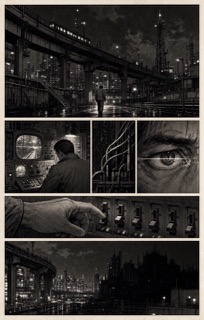
Gekiga — AI-generated interpretation
AI interpretation, not a reference

Gekiga

劇画 / 1957–1970s / Style / Illustration Styles

The name Tatsumi Yoshihiro raised in order to separate his work from manga for children. With a thin drawn line, heavy shadow and cinematic panel flow, it treated adult social themes and violence. It decisively widened the range of subjects comics could take on afterwards.

Thin, hard drawn line / Strong light and dark with solid black / Cinematic panel division / Realistic bodies and backgrounds

design.mdimage prompt

470

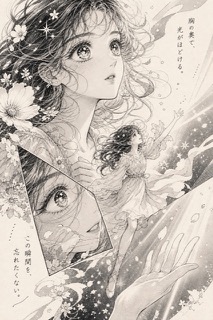
Shōjo Manga — AI-generated interpretation
AI interpretation, not a reference

Shōjo Manga

少女漫画 / 1950s– / Style / Illustration Styles

A field that built its own grammar for translating psychology into space. Panels are broken open, flowers and stars scatter across the background, and the inner voice runs out into the margins. The large eyes and the overlaid panels are devices for drawing the flow of feeling rather than the flow of time.

Figures and panels that cross the frame / Flowers and light streaming through the background / Eyes drawn large and worked in detail / Monologue spilling into the margins

design.mdimage prompt

471

Anime Style — Danny Choo, character design by Azami Yuko, Mirai Suenaga, character of Culture Japan, 2011 — Wikimedia Commons / CC BY-SA 2.0

Anime Style

アニメ絵 / 1960s– / Style / Animation Techniques

The drawing conventions Japanese television animation accumulated in order to deliver the most information from the fewest drawings. A unified, sign like face, clarity of contour, and speed produced by held drawings and effects have influenced drawing styles around the world.

Eyes and nose placed as signs / Contour lines of even weight / Painting that splits shading into two steps / Held drawings used together with speed lines

design.mdimage prompt

472

Material Design — Google, Material Design UI components — Wikimedia Commons / Public domain

Material Design

マテリアルデザイン / 2014– / Style / Google UI

A design system that reduces the physical metaphor of paper and ink to rules of shadow and overlap. Elements are given elevation, shadow states the hierarchy, and motion carries physical cause and effect. It became the model for UI design being distributed as a system. The 2021 revision added colour derived from the device wallpaper, so the palette differs from one user to the next.

Hierarchy and shadow expressed by elevation / Surfaces overlapping like sheets of paper / Motion that shows cause and effect / A standardized unit of spacing

design.mdimage prompt

473

Shibori — Utagawa Hiroshige, Famous Views of the Fifty-three Stations of the Tōkaidō, no. 41 Narumi, shop of the local Arimatsu shibori, 1855 — Wikimedia Commons / Public domain

Shibori

絞り染め / 8th century– / Technique / Textile Traditions

A technique in which cloth is stitched, bound or clamped between boards before dyeing, so that only the parts under pressure stay white. The result is left to the strength of the craftsman's hands and the movement of the cloth, and no two pieces come out alike even from the same pattern.

The bled white left by binding / Regular grain from stitch resist / Geometric ground patterns from board clamping / A texture that keeps the relief of the cloth

design.mdimage prompt

474

Ikat — Patan patola double ikat (Gujarat, India, trade cloth for the Indonesian market) — Wikimedia Commons / CC BY-SA 4.0 · © Jainamishra

Ikat

絣 / ancient– / Technique / Textile Traditions

A technique in which the threads are bound and dyed before weaving, calculated so that the pattern appears only once the cloth is woven. A slight shift of the threads blurs the outline, and that wavering is the fingerprint of ikat. Design and chance live in the same process.

Pattern edges where the outline bleeds / Warp and weft dyed separately / Calculated placement of color / Wavering caused by shifts in the weave

design.mdimage prompt

475

Suminagashi — Nishi Honganji Sanjūrokunin kashū, Tsurayuki shū volume 1, suminagashi paper, early 12th century — Wikimedia Commons / Public domain

Suminagashi

墨流し / 12th century– / Technique / Decorated Paper

A technique in which concentric rings of ink dropped on the surface of water are disturbed by breath or brush and then lifted onto paper. The flow that appears on each sheet cannot be repeated, and from Heian period decorated papers to contemporary bookbinding it has continued as a method for inviting chance on purpose.

Streamlines of disturbed concentric rings / Layers made by the density of the ink / A pattern different on every sheet / Edges that keep the tension of the water surface

design.mdimage prompt

476

Chromolithography — Liebig trading card, Woman of Naples, 19th century — Wikimedia Commons / Public domain

Chromolithography

多色石版 / 1830s–1930s / Technique / Planographic Printing

Multicolor printing in which a separate lithographic stone is prepared for each color and the stones are overlaid in exact register. A dozen or more stones built up an intensity like oil paint and sent reproductions, labels, posters and cards into the world in quantity. The popularization of color printing begins here.

Dense color built from a dozen or more stones / Slight misregister between the stones / Flat solids used together with stipple / Border ornament used together with gold

design.mdimage prompt

477

Iznik Pottery — Iznik dish, late 16th century, photo Faqscl — Wikimedia Commons / CC BY-SA 4.0

Iznik Pottery

イズニク陶器 / 15th–17th century / Style / Ceramic Styles

The pottery reached by the Ottoman kilns, setting brilliant blue and red on a white body. Tulips and carnations turn in spirals around the curve of the vessel, and on the wall tiles of a mosque geometry and plant ornament coexist on a single surface.

The brilliance of a white body under transparent glaze / Cobalt blue and a red that stands in relief / Spiralling plant ornament / A continuous composition turning around a curved surface

design.mdimage prompt

478

Literati Painting — Ni Zan, Six Gentlemen, 1345 — Wikimedia Commons / Public domain

Literati Painting

文人画 / 11th century– / Style / East Asian Painting

A Chinese painting tradition that values scholarly cultivation and personal expression. Brushwork relates to character and the study of earlier paintings, while image, poetry, calligraphy and seals interact. Detail, colour and professional practice vary by artist and period; the tradition is not limited to unpaid work by nonprofessional painters.

Calligraphic brushwork and references to earlier painting / Relations among image, poetry, calligraphy and seals / Ink tones and, in some works, light colour / Personal expression through subject and brushwork

design.mdimage prompt

479

Platinum — Mac OS 8.1 desktop and "About This Mac" — Wikimedia Commons / CC0

Platinum

プラチナ / 1997–2001 / Style / Apple UI

Apple's own name for the default appearance of Mac OS 8, shipped alongside the Appearance Manager, a framework built so the entire look could later be swapped for another. It drains the color out of the interface and works in grays alone, embossing whatever can be pressed and flattening whatever cannot until it merges with the background. The newly thickened window frame was a signal that the window could now be dragged by any edge.

Windows and controls built entirely from desaturated grays / Live controls carry a bevel and stand up, while disabled ones go flat and sink into the same gray as the background / Thick molded window frames sitting next to modal dialogs that have almost no frame at all / A collapse box at the right end of the title bar, and pop up menus raised into buttons with a double triangle

design.mdimage prompt

480

Apple Desktop Interface — Macintosh System 3 screen, 1986 — Wikimedia Commons / CC0

Apple Desktop Interface

アップル・デスクトップ・インターフェース / 1984–1997 / Style / Apple UI

This is the design language Apple named itself, in the 1987 guidelines book whose subtitle reads The Apple Desktop Interface. Working with one bit of black and white, it wrote down a house style: halftone dot patterns standing in for gray, rounded window corners, a title bar of stacked horizontal rules, and a heavy bitmap face.

Two tones only, black and white, with gray faked by a checkerboard of black dots / Window corners are rounded and the title bar carries several thin horizontal rules / A menu bar pinned to the top edge of the screen, the Apple mark sitting at its left end / Chicago, a heavy bitmap face whose letters are packed into a cell of 9 by 7 dots

design.mdimage prompt

Editorial policy

IndexStyle is not a list of every term used around design. An independent entry must describe a visual language that can be recognised, reproduced and distinguished from its neighbours. Editorial standard

Back to top