Grunge Fashion
グランジ・ファッション / late 1980s–1990s / Style / Subculture Style
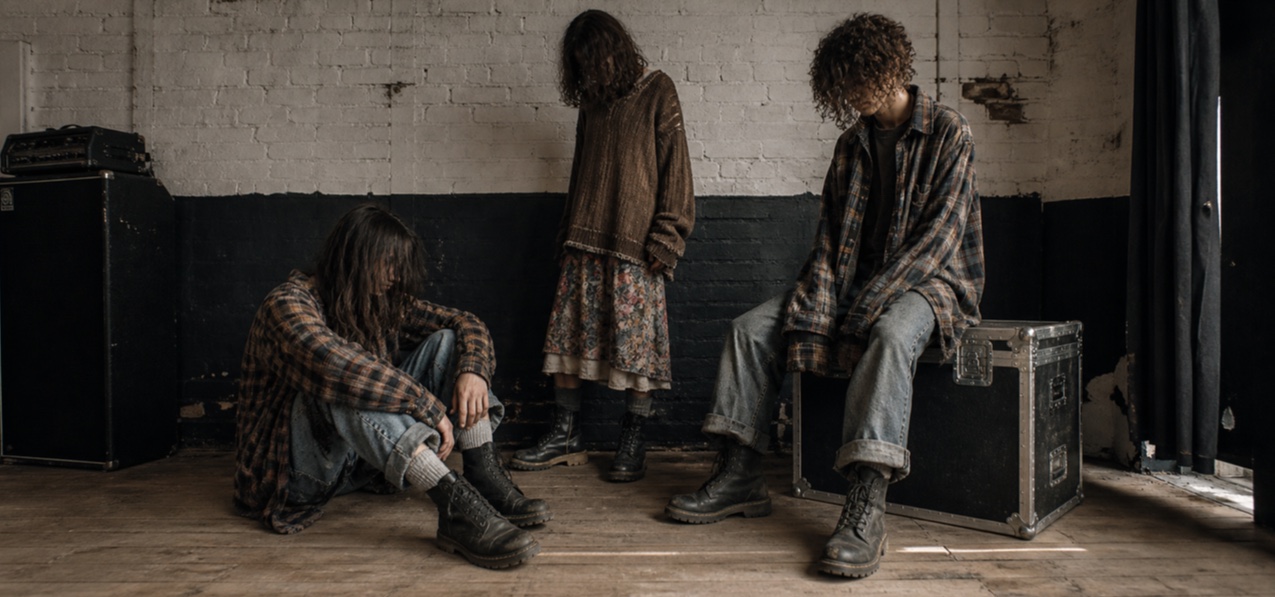
Grunge fashion grew from mismatched, layered secondhand and work clothing in the Pacific Northwest music scene before its early-1990s runway translation; flannel, worn knits, boots and displaced hems became an answer to polished luxury.


At a glance
Visual cues
- Oversized checked flannel worn open in layers
- Pilled knit, thrifted dress and distressed denim mixed
- Heavy work boots and off-body sizing
- Muddy earth tones and washed black layered together
Best used for
- Building an unpolished counter-image for music, magazines and styling
- Turning secondhand utility clothing and wear into value through new combinations
Use this style
Take the compact brief into a project or hand the structured version to an AI tool.
Detailed guidance and sourcesProduction rules, reference works, comparisons, research and citation formats
Dictionary entry
- Type
- Keep distressed sans or typewriter copy small and let layering lead.
- Composition
- Place oversized shirts and knits over narrow inner layers, displacing shoulder and hem lines.
- Material
- Use washed flannel, pilled knit, faded denim and dull leather, avoiding new gloss.
- Caution
- Buying pre-ripped clothes misses the point. Preserve the distance from fashion that came from thrift, utility and a regional music culture.
- Further study
- Pacific Northwest music scene / 1993 grunge collections / Secondhand layering
Related entries
- Grunge (グランジ)Shared effects: Rebellion / Nostalgia.Compare Grunge Fashion and Grunge
- Fashion Deconstruction (ファッションの脱構築)Shared effects: Rebellion.Compare Grunge Fashion and Fashion Deconstruction
More from Subculture Style
Continue through styles in the same Subculture Style family, prioritised by shared effects.
- Emo Style (エモ・スタイル)Shared effects: Intimacy / Rebellion / Nostalgia.
- Mall Goth (モール・ゴス)Shared effects: Rebellion / Nostalgia / Intimacy.
- Teddy Boys (テディボーイズ)Shared effects: Rebellion / Nostalgia.
Browse all Subculture Style entries
Cite this entry
The dictionary is meant to be linked to. Take whichever form fits where you are writing.
- Link
- https://indexstyle.org/styles/grunge-fashion
- Markdown
- [Grunge Fashion — IndexStyle](https://indexstyle.org/styles/grunge-fashion)
- HTML
- <a href="https://indexstyle.org/styles/grunge-fashion">Grunge Fashion — IndexStyle</a>