Neo-Dada
ネオ・ダダ / 1953–1965 / Style / Postwar American Art
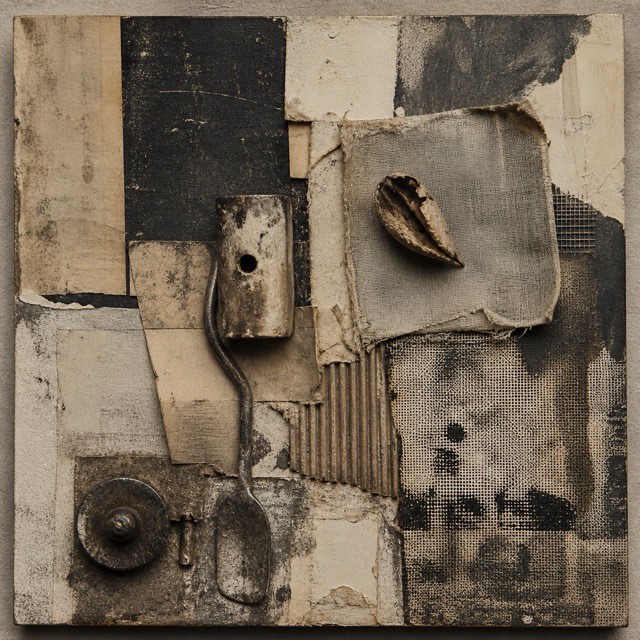
A postwar current that answered the inwardness of Abstract Expressionism by bringing household objects, printed matter and taxidermy onto the picture, working in the gap between art and life. It inherited Dada's gestures while making the materials of consumer society into structural components. The branching point immediately before Pop art.


At a glance
Visual cues
- Ready-made objects brought onto the picture
- Printed matter transferred by silkscreen
- Forms halfway between painting and object
- Traces of erasing, layering and soiling
Best used for
- Record sleeves, zines and event graphics that need to look assembled out of the world rather than designed from nothing
- Campaigns built from found print, where the receipts, newsprint and packaging keep their own history as part of the message
Use this style
Take the compact brief into a project or hand the structured version to an AI tool.
Detailed guidance and sourcesProduction rules, reference works, comparisons, research and citation formats
Dictionary entry
- Type
- Mixed sizes and mixed faces from whatever was to hand, some stencilled, some torn out of existing print.
- Composition
- No grid: a horizontal collage in which one three-dimensional object breaks the picture plane and pulls the eye off axis.
- Material
- Silkscreened newsprint over smeared paint, registration deliberately out, erasures left visible.
- Caution
- Pasting readymades alone never shows why they were chosen, and it becomes a shelf of knickknacks. Arranging it tidily strips the dirt and scale the work depends on, and leaves clean decoration.
- Further study
- The definition of the Combine painting / Japan's Neo-Dadaism Organizers / Its proximity to Fluxus
Related entries
- Dada (ダダ)Shared effects: Rebellion / Play.Compare Neo-Dada and Dada
- Pop Art (ポップアート)Shared effects: Play.Compare Neo-Dada and Pop Art
Often confused with
More from Postwar American Art
Continue through styles in the same Postwar American Art family, prioritised by shared effects.
- Funk Art (ファンク・アート)Shared effects: Play / Rebellion.
- Abstract Expressionism (抽象表現主義)Shared effects: Rebellion.
- Conceptual Art (コンセプチュアル・アート)Shared effects: Rebellion.
Browse all Postwar American Art entries
Cite this entry
The dictionary is meant to be linked to. Take whichever form fits where you are writing.
- Link
- https://indexstyle.org/styles/neo-dada
- Markdown
- [Neo-Dada — IndexStyle](https://indexstyle.org/styles/neo-dada)
- HTML
- <a href="https://indexstyle.org/styles/neo-dada">Neo-Dada — IndexStyle</a>