Op Art Fashion
オプ・アート・ファッション / 1964–late 1960s / Style / Fashion History
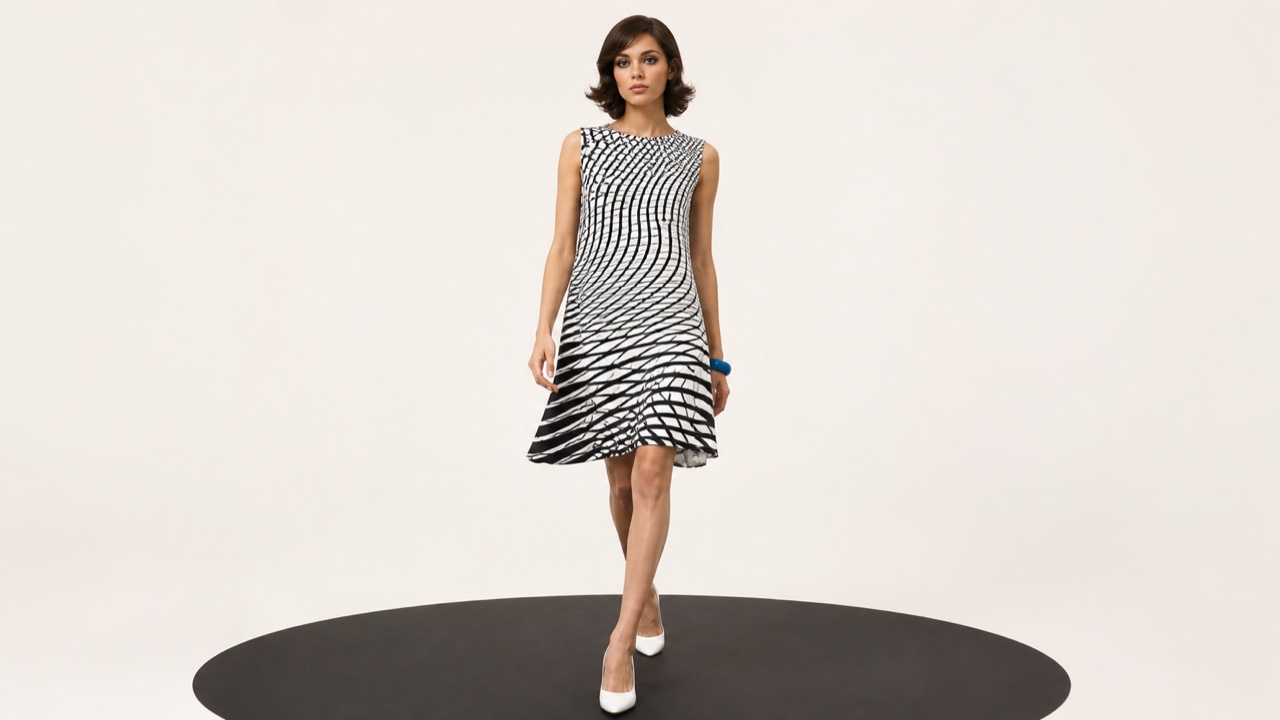
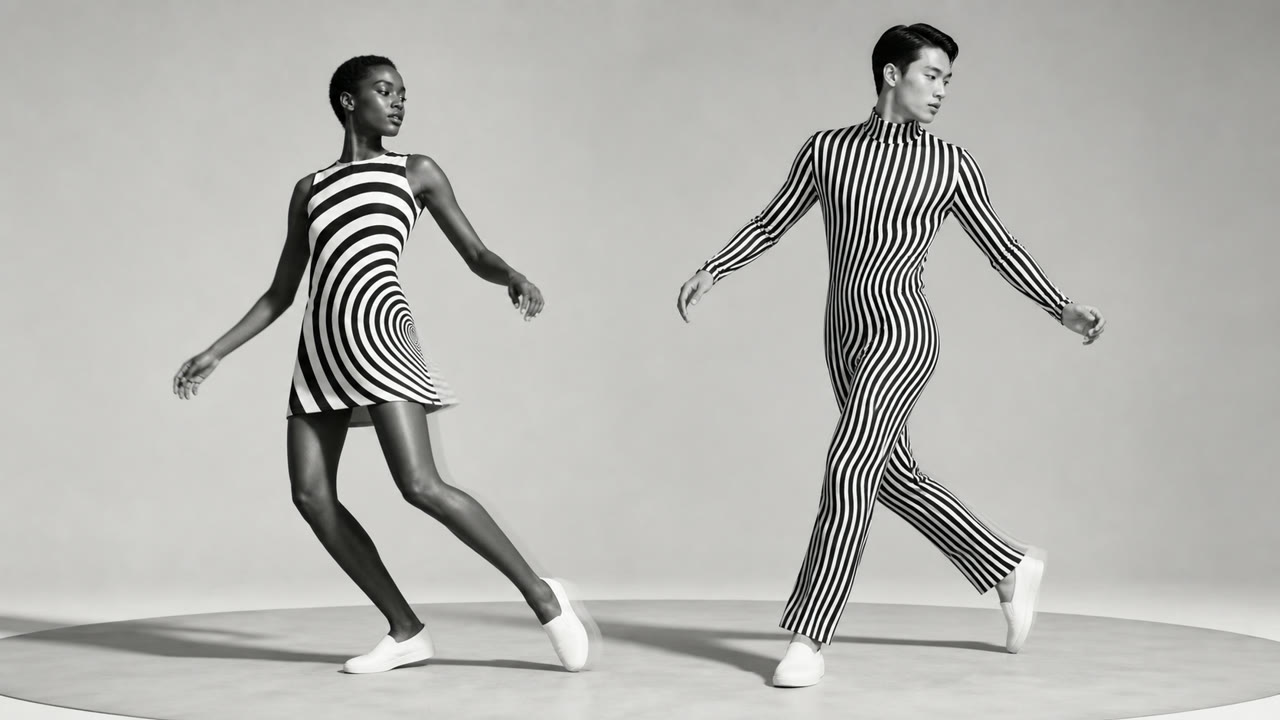
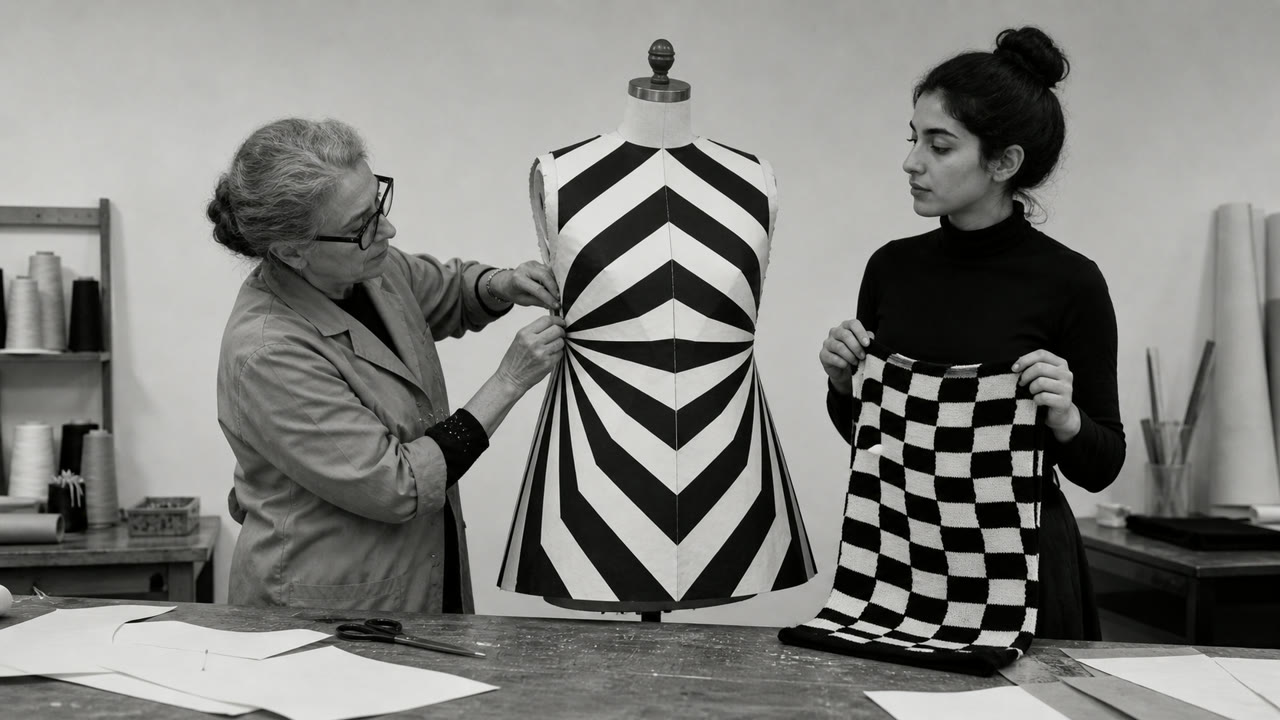
1960s Op Art fashion moved repeated lines, sharp black-and-white contrast and perceptual vibration into straight mini-dresses, knits and paper clothing, letting the pattern swell, flicker and turn as the body moves.
At a glance
Visual cues
- High-contrast black-and-white lines, grids, waves and concentric forms
- Geometry repeated finely enough to unsettle the eye
- Simple shift silhouettes that leave patterns unbroken
- All-over prints whose distortion changes with walking and body curvature
Best used for
- Using body movement to produce stronger optical effects than a still image in performance or photography
- Making a 1960s fashion statement legible at distance with few colors and a simple pattern
Use this style
Take the compact brief into a project or hand the structured version to an AI tool.
Detailed guidance and sourcesProduction rules, reference works, comparisons, research and citation formats
Dictionary entry
- Type
- Set a heavy sans in a plain band so it does not compete with the pattern frequency.
- Composition
- Use a straight form with few seams and carry the optical period uninterrupted from chest to hem.
- Material
- Vary line width and spacing in two high-contrast colors, then fit-test how stretch and curvature alter the effect.
- Caution
- Not every geometric print is Op Art. The structure must create perceptual vibration, expansion or depth.
- Further study
- 1966 Scott Paper op-art dress / Bridget Riley and optical pattern / Paper clothing and mass promotion
Related entries
- Op Art (オプ・アート)Shared effects: Exhilaration / Technique.Compare Op Art Fashion and Op Art
- Space Age Fashion (スペースエイジ・ファッション)Same Fashion History lineage.Compare Op Art Fashion and Space Age Fashion
More from Fashion History
Continue through styles in the same Fashion History family, prioritised by shared effects.
- Flapper (フラッパー)Shared effects: Exhilaration / Play.
- Meisen Kimono (銘仙)Shared effects: Play / Exhilaration.
- Camp Fashion (キャンプ・ファッション)Shared effects: Play / Exhilaration.
Browse all Fashion History entries
Cite this entry
The dictionary is meant to be linked to. Take whichever form fits where you are writing.
- Link
- https://indexstyle.org/styles/op-art-fashion
- Markdown
- [Op Art Fashion — IndexStyle](https://indexstyle.org/styles/op-art-fashion)
- HTML
- <a href="https://indexstyle.org/styles/op-art-fashion">Op Art Fashion — IndexStyle</a>