Op Art Fashion vs Space Age Fashion
オプ・アート・ファッション / スペースエイジ・ファッション
Both sit in Fashion History, so the question is not what they belong to but how they behave. They are reached for with some of the same intent, which is where they get confused.
Op Art Fashion
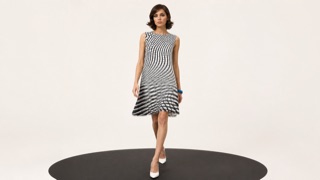
1960s Op Art fashion moved repeated lines, sharp black-and-white contrast and perceptual vibration into straight mini-dresses, knits and paper clothing, letting the pattern swell, flicker and turn as the body moves.
Space Age Fashion


The couture avant-garde of the 1960s translated the optimism of the space race into experiments with material, using metal, plastic and geometric cuts to present the body as an object of the future.
| Op Art Fashion | Space Age Fashion | |
|---|---|---|
| Era | 1964–late 1960s | 1960s |
| Family | Fashion History | Fashion History |
| Kind | Style | Style |
| Cues | High-contrast black-and-white lines, grids, waves and concentric forms / Geometry repeated finely enough to unsettle the eye / Simple shift silhouettes that leave patterns unbroken / All-over prints whose distortion changes with walking and body curvature | Mini A-lines / Metal and plastic / Helmets and goggles / White and silver |
| Best used for | Using body movement to produce stronger optical effects than a still image in performance or photography · Making a 1960s fashion statement legible at distance with few colors and a simple pattern | Stage costume and announcements where technological optimism must read instantly · Presenting experimental garments where the material itself is the subject |
| Type | Set a heavy sans in a plain band so it does not compete with the pattern frequency. | Geometric sans capitals aligned to circles and squares |
| Composition | Use a straight form with few seams and carry the optical period uninterrupted from chest to hem. | Simplify the body into trapezoid and circle, exposing legs and face |
| Material | Vary line width and spacing in two high-contrast colors, then fit-test how stretch and curvature alter the effect. | White and silver, vinyl, metal plates and chain, linked not sewn |
| Caution | Not every geometric print is Op Art. The structure must create perceptual vibration, expansion or depth. | Adding silver and porthole shapes alone yields a familiar costume, and without real material experiment it reads as nostalgia rather than the future. |