DeepDream
ディープドリーム / 2015– / Technique / Digital Art
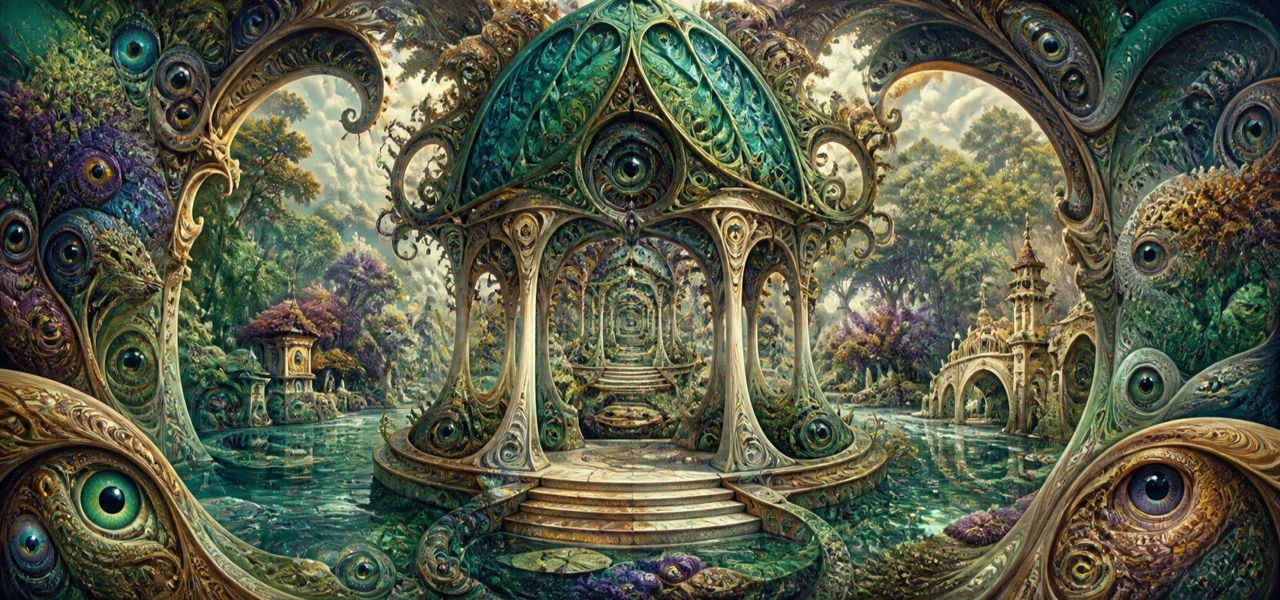
Google's visualization technique repeatedly amplifies features learned by an image-recognition network, making eyes, animals and towers emerge excessively from clouds, rocks and leaves until misrecognition becomes a recursive hallucinatory surface.


At a glance
Visual cues
- Eyes and animal faces repeated across the frame
- Swirling texture multiplying along source contours
- Multi-scale repetition that reveals new figures when viewed closer
- Saturated blue, yellow and violet rolling continuously
Best used for
- Exhibits and critical images that make machine misrecognition immediately visible
- Music video and cover imagery that keeps a source landscape beneath a multi-scale hallucination
Use this style
Take the compact brief into a project or hand the structured version to an AI tool.
Detailed guidance and sourcesProduction rules, reference works, comparisons, research and citation formats
Dictionary entry
- Type
- Add type after processing, keeping it short, bold and simple enough not to fight the detail.
- Composition
- Preserve the source's large composition and amplify related features at several scales to create recursion into depth.
- Material
- Choose layers in a trained vision model and iteratively increase their activation through gradient ascent.
- Caution
- It is not a swirl filter or pasted dog faces. Preserve which layer and feature were amplified and how they bind to the source.
- Further study
- Feature visualization and layer selection / Iterative zoom and octave scales / GoogLeNet ImageNet feature bias
Related entries
- Generative Art (ジェネラティブアート)Same Digital Art lineage.Compare DeepDream and Generative Art
- Psychedelic (サイケデリック)Shared effects: Exhilaration.Compare DeepDream and Psychedelic
More from Digital Art
Continue through styles in the same Digital Art family, prioritised by shared effects.
- Low Poly (ローポリ)Shared effects: Technique / Futurity.
- Cracktro (クラックトロ)Shared effects: Technique / Exhilaration.
- Net.art (ネット・アート)Shared effects: Technique.
Browse all Digital Art entries
Cite this entry
The dictionary is meant to be linked to. Take whichever form fits where you are writing.
- Link
- https://indexstyle.org/styles/deepdream
- Markdown
- [DeepDream — IndexStyle](https://indexstyle.org/styles/deepdream)
- HTML
- <a href="https://indexstyle.org/styles/deepdream">DeepDream — IndexStyle</a>