Playing Card Design
トランプの意匠 / 15th century– / Style / Games and Play
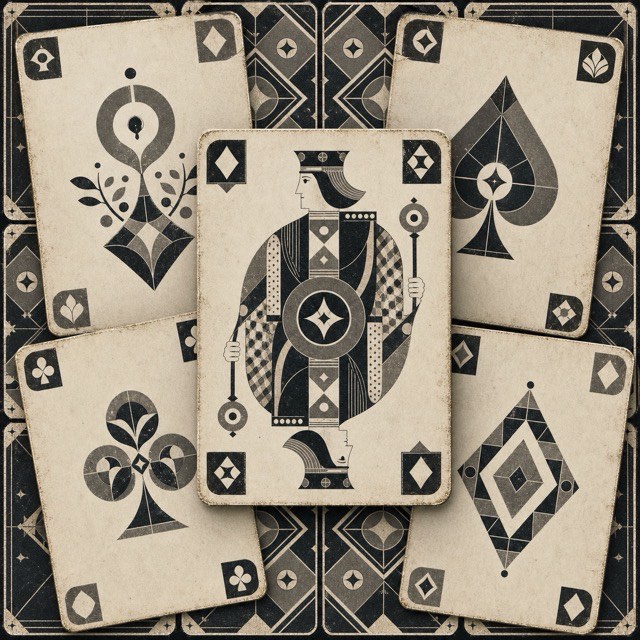
The 52-sheet design polished by centuries of use: double-ended court cards, the semiotics of suits, repeating back patterns. Wear and recognition produced a completeness that is also the prehistory of UI design.


At a glance
Visual cues
- Double-ended court cards
- Suit signs
- Corner indices
- Repeating back patterns
Best used for
- Card-shaped tools and games handled hundreds of times in the hand
- Sign and color systems that must be told apart instantly in poor light
Use this style
Take the compact brief into a project or hand the structured version to an AI tool.
Detailed guidance and sourcesProduction rules, reference works, comparisons, research and citation formats
Dictionary entry
- Type
- Corner indices large and plain, detail reduced inside the court figure
- Composition
- Everything built double-ended so a half turn changes nothing
- Material
- A repeating back pattern hiding wear, held off the edge
- Caution
- Favoring an interesting picture and shrinking the corner index makes the card unreadable the moment a hand is held in a fan.
- Further study
- the Rouen pattern lineage / the invention of indices / regional standard patterns
Related entries
- Tarot Imagery (タロットの図像)Same Games and Play lineage.Compare Playing Card Design and Tarot Imagery
- Hanafuda (花札)Same Games and Play lineage.Compare Playing Card Design and Hanafuda
More from Games and Play
Continue through styles in the same Games and Play family, prioritised by shared effects.
- E-Sugoroku (絵双六)Shared effects: Play / Nostalgia.
- ADV / NVL Text Layout (ADV/NVL(ノベルゲームの文字組み))
Browse all Games and Play entries
Cite this entry
The dictionary is meant to be linked to. Take whichever form fits where you are writing.
- Link
- https://indexstyle.org/styles/playing-card
- Markdown
- [Playing Card Design — IndexStyle](https://indexstyle.org/styles/playing-card)
- HTML
- <a href="https://indexstyle.org/styles/playing-card">Playing Card Design — IndexStyle</a>