Arte Povera vs Mono-ha
アルテ・ポーヴェラ / もの派
Arte Povera comes from Italian Avant-garde and Mono-ha from Modern and Contemporary Art Movements. They are reached for with some of the same intent, which is where they get confused.
Arte Povera


Takes up earth, branches, cloth, stone, fire and metal, materials that are neither precious nor stable, and uses them to intervene in the commodification of art and the values of industrial society.
Mono-ha
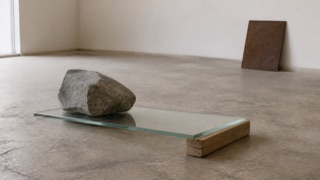
A Japanese tendency that placed stone, wood, glass, steel, and cotton with minimal transformation to expose relations among things, site, support, fracture, and gravity rather than constructing a finished shape.
| Arte Povera | Mono-ha | |
|---|---|---|
| Era | 1967–1970s | late 1960s–1970s |
| Family | Italian Avant-garde | Modern and Contemporary Art Movements |
| Kind | Style | Style |
| Cues | Non-precious materials / Change and decay / Nature against industry / Bare assembly | Natural and industrial matter placed in pairs or small groups / Visible cutting, support, pressure, and gravity / Floor and wall contact replacing a strong pedestal / Largely unprocessed stone, steel, wood, cotton, and glass |
| Best used for | Installations where the material changing over time is written into the plan. · Spaces that put an industrial product beside a natural one and make the gap the subject. | Making contact, support, and weight legible instead of using material as a symbol · Letting architecture or product displays hold the boundary between natural and industrial matter |
| Type | Let the title be a list of the materials, with no metaphor added. | Move explanation to the wall and name only the material relation. |
| Composition | Set the work on the floor and refuse the plinth and the spotlight. | Set distance, contact, and center of mass between two materials and keep walk-around space. |
| Material | Earth, wax, cloth, metal and living plants, worked as little as possible. | Use stone, steel plate, wood, cotton, or glass without cosmetic finishing, concealing only the safety engineering. |
| Caution | Do not reduce this to the mood of aged materials, and keep its critique of value, time, labor and institution. Over conditioning the display turns the work into an unchanging specimen. | Placing a stone is not enough. If the relation among material, placement, and site cannot be stated, it becomes display rather than Mono-ha. |