Spatialism vs ZERO
スパツィアリズモ / ZERO
Spatialism comes from Italian Avant-garde and ZERO from Postwar Abstract Painting. They are reached for with some of the same intent, which is where they get confused.
Spatialism


An Italian movement that slashed and punctured the canvas to open painting from two-dimensional illusion into actual space. The darkness behind the cut appears as real depth, and the support itself becomes the work. The precedent that turned breaking a material's surface into a formal language.
ZERO
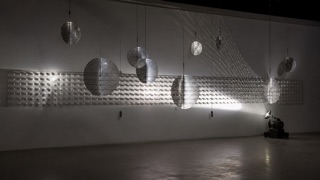
An international postwar network that restarted from a 'zero point,' replacing gestural painting with monochrome repetition, light, fire, air, and movement so physical phenomena and the viewer's motion become the work.
| Spatialism | ZERO | |
|---|---|---|
| Era | 1947–1968 | 1957–1966 |
| Family | Italian Avant-garde | Postwar Abstract Painting |
| Kind | Style | Style |
| Cues | Slits and punctures in the canvas / Surfaces painted a single colour / Darkness appearing behind the cuts / Presentation of the support itself | Repeated surfaces in white, silver, or black / Metal, mirrors, and relief changing under light / Real-time change through motors, air, or flame / Uniform repetitions of points, holes, discs, or grids |
| Best used for | Museum and theatre announcements where one incision in a monochrome plane is the whole statement · Packaging and covers where a single die-cut or torn reveal is the form itself | Designing exhibitions that change as light and the viewer move · Making repeated components and physical phenomena primary instead of the artist's brushmark |
| Type | A single refined sans, set sparsely; the cut, not the type, is the headline | Use small widely spaced geometric sans-serif away from moving surfaces. |
| Composition | One monochrome field with a small number of incisions placed with extreme economy | Repeat one component regularly and leave enough oblique circulation for reflected light to change. |
| Material | Uniform matte monochrome; real cuts, punctures or die-cuts revealing shadow behind | Combine white relief, polished metal, mirrors, point light, and slow motors with heat and wiring safely isolated. |
| Caution | Avoid multiplying the cuts into pattern—the gesture works only while each incision remains a singular breach of an otherwise perfect surface. | Do not collapse ZERO into white Minimalism; light, motion, phenomena, and its international network are central. |