Pixelscape vs Web 1.0
ピクセルスケープ / ウェブ1.0
Pixelscape comes from Internet Aesthetics and Web 1.0 from Digital Retro. They are reached for with some of the same intent, which is where they get confused.
Pixelscape
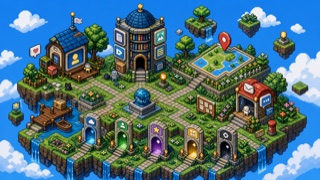
An early-2000s web style that densely draws cities, rooms, and landscapes as small isometric pixels, turning an entire site into an explorable world. Its defining feature is spatial navigation, not pixel art in isolation.
Web 1.0

Reuses the naivety of the constrained early web as directness and charm. In the 2020s it came back as a movement to take the personal site back, gathering under names like Neocities and Yesterweb.
| Pixelscape | Web 1.0 | |
|---|---|---|
| Era | early–mid-2000s | 1990s |
| Family | Internet Aesthetics | Digital Retro |
| Kind | Style | Style |
| Cues | Isometric cities and rooms seen from above / Dense placement of tiny people, furniture, and signs / Tile-based floors, walls, water, and roads / Buttons and links embedded as objects in the landscape | Blue links / Low-res GIFs / System fonts / Plain buttons |
| Best used for | Games, city guides, and cultural venues whose entrance should feel like exploring a world · Reconstructing early-web pixel culture as site structure rather than a single illustration | Showing affection for internet culture · An unpolished, approachable feel |
| Type | Fit type to the pixel grid and place it in-world as signage or screens; move long copy to a fixed separate panel. | System sans and monospace |
| Composition | Define one isometric tile size, then use roads and buildings to guide attention toward destinations. | Left-aligned, borders, table-like division |
| Material | Use a limited palette, integer scaling, tiles, and sprites with image interpolation disabled. | White background, blue links, dithered images |
| Caution | One isometric illustration is not enough. Links, movement, and information hierarchy must correspond to places in a navigable site. | Don't regress actual accessibility. Separate the look from interaction quality. |