New Topographics vs Typology Photography
ニュー・トポグラフィックス / タイポロジー写真
Both sit in Photography Movements, so the question is not what they belong to but how they behave. They are reached for with some of the same intent, which is where they get confused.
New Topographics
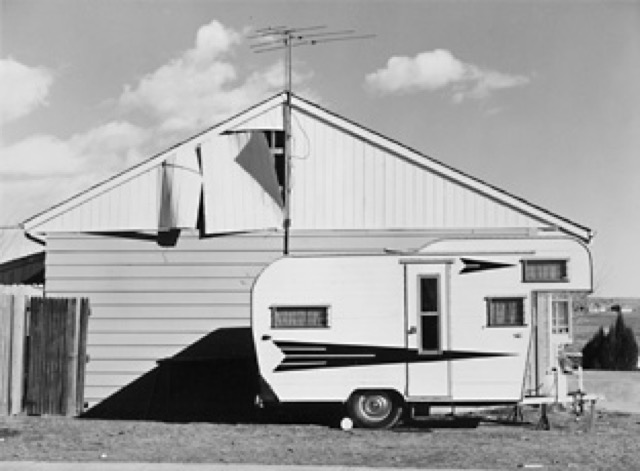
Turns from grand natural scenery to the landscapes people have altered, recording suburbs, graded building sites and industrial zones without heat.
Typology Photography


The Bechers' method of shooting one kind of structure under identical conditions and hanging the results in a grid. Repetition under overcast light, dead-on and without people, turns individuals into types, and by way of the Düsseldorf school it became a grammar of contemporary photography.
| New Topographics | Typology Photography | |
|---|---|---|
| Era | 1975– | 1959– |
| Family | Photography Movements | Photography Movements |
| Kind | Style | Style |
| Cues | Empty suburbs / Frontality / Dry color / Man-altered landscape | Grid presentation / Even overcast light / Strict frontality / Typification through repetition |
| Best used for | Recording how a city edge or a graded site changes, year after year, under identical conditions. · Reports and exhibitions that present development as it is, without staging. | Surveys recording one class of facility or equipment so they can be compared · Laying out a collection or product range so only the differences show |
| Type | Captions carry place and date only, in one fixed form, with no comment. | Lettering kept outside the frame, place and date in one format throughout |
| Composition | Hold the horizon near the middle and shoot subjects square on at equal distance. | An even grid with the subject held at the same size in every frame |
| Material | Even overcast light, deep focus, processing that never lifts saturation. | Frontal shooting under flat overcast light, focal length and height fixed |
| Caution | Posing as neutral while choosing light and framing too carefully produces scenic photography in documentary clothes, and the change goes unread. | Hanging pictures made under different light and angles turns those differences into the subject, and the variation between objects disappears. |