Mid-century Picture Book vs Soviet Picture Book
ミッドセンチュリーの絵本 / ソビエト絵本
Mid-century Picture Book comes from Illustration Styles and Soviet Picture Book from Publishing and Editing. Both are read here as style. They are reached for with some of the same intent, which is where they get confused.
Mid-century Picture Book
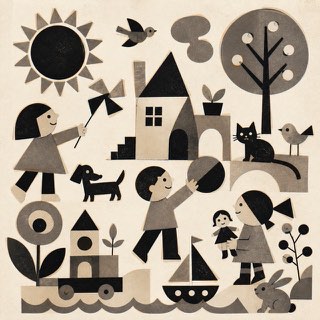
The postwar golden age of the picture book: flat limited color unafraid of misregistration, simplified figures and playful unity of type and image bringing modernist form into children's daily lives.
Soviet Picture Book
%20by%20S.%20Poltavsky%20-%20cover.jpg)
%2001.jpg)

The children's books of the revolutionary avant-garde: Lebedev and others brought constructivist flatness and simple shapes to storytelling, making cheap lithographed picture books a laboratory of 20th-century book design.
| Mid-century Picture Book | Soviet Picture Book | |
|---|---|---|
| Era | 1940s–1960s | 1920s–1930s |
| Family | Illustration Styles | Publishing and Editing |
| Kind | Style | Style |
| Cues | Flat limited color / The charm of misregistration / Simplified figures / Type and image as one | Constructivist flatness / Machines and labor simplified / Text and image designed as one / Limited lithographic color |
| Best used for | Children's picture books printed warmly in a small number of colors · Teaching materials or family-facing signage needing friendly flat illustration | Picture books and teaching material explaining how machines and work function · Booklets and exhibition panels printed within a strict color limit |
| Type | Plain serif set large for the text, hand lettering kept to headings | Type placed as a compositional element, lines running along the shapes |
| Composition | Picture and text swapping sides spread by spread to build page rhythm | Design each spread as one figure, movement across the gutter carrying it |
| Material | Two or three flat inks overlapped, misregistered edges and paper white kept | Two or three lithographic colors, overlaps making the intermediate tones |
| Caution | Copying the nostalgic palette while rendering figures realistically kills the lightness that flatness and simplification carried. | Arranging flat shapes without designing the order of the story kills the movement of turning the page, and a child cannot follow it. |