Machine Art vs Ulm School (HfG Ulm)
マシン・アート / ウルム造形大学
Machine Art comes from Modern Design Movements and Ulm School (HfG Ulm) from Postwar Industrial Design. They are reached for with some of the same intent, which is where they get confused.
Machine Art
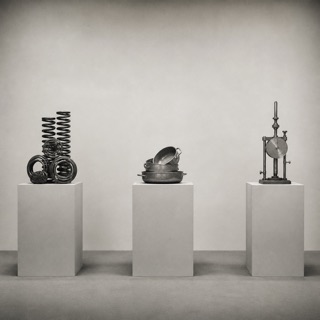
The name of an exhibition the Museum of Modern Art held in New York from March to April 1934. Springs, pots and pans and scientific instruments, all factory made and all utilitarian, were placed on pedestals and treated as sculpture. Philip Johnson screened the walls and ceilings of the museum's nineteenth century brownstone to hide its mouldings, so that undecorated objects could be seen against nothing.
Ulm School (HfG Ulm)


Founded by Max Bill as the Bauhaus's successor, the school redefined design as science, method and system. Its collaboration with Braun made the functionalist face a world standard.
| Machine Art | Ulm School (HfG Ulm) | |
|---|---|---|
| Era | 1934 | 1953–1968 |
| Family | Modern Design Movements | Postwar Industrial Design |
| Kind | Style | Style |
| Cues | Utilitarian factory parts set out one to a pedestal, spaced apart / Mouldings on walls and ceilings screened over, leaving a background with no pattern in it / The objects are springs, pans and instruments, things never made to be looked at / Manufacturers' names standing where an artist's name would normally go | Method and system / Grids and modules / Ornament excluded / Design as science |
| Best used for | Shooting a set of parts or tools by stripping every pattern out of the background and the fixtures and giving each object its own plinth · Selling an undecorated product on a page that leads with the form alone and holds the feature copy back | Aligning a product family and its markings as one system of rules · Building a device whose operation is explained by symbols and color rules alone |
| Type | Only the object's name and its maker, small, in one undecorated face. No adjectives. | One sans face, three sizes at most, everything ranged left |
| Composition | One plinth per object, evenly spaced, with nothing added to the background plane. Cover over any trim or moulding rather than working around it. | Lay out controls and displays on a grid of modular dimensions |
| Material | Metal, glass and porcelain as they come from the factory. No paint and no pattern, so that tooling marks and sheen are all there is to see. | Neutral surfaces with one or two colors allowed to mark function |
| Caution | Assuming the work is done once the objects are undecorated leaves the room and the fixtures decorated, and the forms lose to the pattern around them. | Borrowing the grey and the grid without deciding the reasoning leaves nobody able to justify a rule, and the system collapses as elements are added. |