Guerrilla Television vs Video Synthesis
ゲリラ・テレビジョン / ビデオ・シンセシス
Both sit in Experimental Film, so the question is not what they belong to but how they behave. One is style and the other technique. They are reached for with some of the same intent, which is where they get confused.
Guerrilla Television
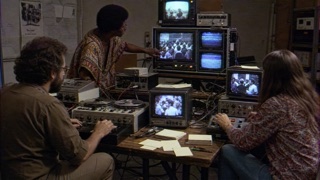
A media movement in which small collectives used portable video to oppose broadcast authority and one-way communication, recording demonstrations, communities, and institutions for rapid editing and alternative circulation. Low resolution, handheld access, feedback, direct titles, and multiple viewpoints became its language.
Video Synthesis
.jpg)


Generating and modulating the video signal itself like an instrument. Nam June Paik and Shuya Abe's synthesizer turned the television from receiver into raw material, opening video art's technical ground.
| Guerrilla Television | Video Synthesis | |
|---|---|---|
| Era | late 1960s–1980s | 1969– |
| Family | Experimental Film | Experimental Film |
| Kind | Style | Technique |
| Cues | Low-resolution portable video, trails, clipping, and dropouts / Long handheld records embedded in events / Handwritten cards, coarse electronic type, and direct time or place labels / Split screens, feedback, and reshooting that dismantle broadcast images | Modulated signal / Feedback vortices / Waveforms made visible / Television sets repurposed |
| Best used for | Making viewpoint and production process visible in civic media · Composing several field records with electronic titles and transmission traces | Live stage visuals generated in time with the performance itself · Work that uses the signal as its material instead of recorded footage |
| Type | State place, time, and speaker with coarse electronic type or cards; never borrow a station identity to fake authority. | Distort letters as signal, moving between legible and collapsed |
| Composition | Keep field footage primary and use split screen, reshooting, or feedback only to expose conflicting viewpoints. | Symmetrical feedback around the center, vortex speed setting composition |
| Material | Retain portable-video resolution, location sound, and tape loss instead of applying one uniform malfunction filter. | Color from oscillator waveforms, layers from camera and monitor recursion |
| Caution | VHS noise alone does not create counter-media. Name the makers, community, circulation, and consent, and do not imitate real stations or emergency broadcasts. | Stopping the moment feedback throws up a pretty accident, then stringing accidents together without learning which control produces which image. |