Gekiga vs Shōjo Manga
劇画 / 少女漫画
Both sit in Illustration Styles, so the question is not what they belong to but how they behave. They are reached for with different intent, which is the fastest way to tell them apart.
Gekiga
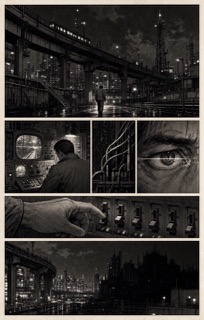
The name Tatsumi Yoshihiro raised in order to separate his work from manga for children. With a thin drawn line, heavy shadow and cinematic panel flow, it treated adult social themes and violence. It decisively widened the range of subjects comics could take on afterwards.
Shōjo Manga
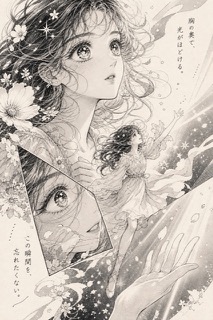
A field that built its own grammar for translating psychology into space. Panels are broken open, flowers and stars scatter across the background, and the inner voice runs out into the margins. The large eyes and the overlaid panels are devices for drawing the flow of feeling rather than the flow of time.
| Gekiga | Shōjo Manga | |
|---|---|---|
| Era | 1957–1970s | 1950s– |
| Family | Illustration Styles | Illustration Styles |
| Kind | Style | Style |
| Cues | Thin, hard drawn line / Strong light and dark with solid black / Cinematic panel division / Realistic bodies and backgrounds | Figures and panels that cross the frame / Flowers and light streaming through the background / Eyes drawn large and worked in detail / Monologue spilling into the margins |
| Best used for | Supporting a heavy subject with the hardness of the line and the quantity of darkness · Designing cinematic time through a sequence of panels | Drawing the flow of feeling in space rather than in time · Letting inner monologue share the page with the image |
| Type | Hold back hand lettering and bring the hardness of phototype onto the page. | Let hand lettering and monologue run into the white space outside the panels. |
| Composition | Swing widely between long shot and close up, and insert silent panels. | Overlap panels and place figures breaking through the frame lines. |
| Material | Build the gradations of darkness from solid black and crosshatched screening. | Make light by layering screentone and cutting out white. |
| Caution | A dark drawing style is not what gekiga is. The starting point is what the hardened line was meant to tell. | Borrowing the eyes and the flowers ends in mere signs. The structure of the panels is what carries the emotion. |