Factory Pomo vs Industrial Americana
ファクトリー・ポモ / インダストリアル・アメリカーナ
Both sit in Industrial and Spatial Design, so the question is not what they belong to but how they behave. They are reached for with some of the same intent, which is where they get confused.
Factory Pomo
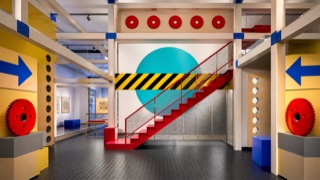
A brief late-1980s and early-1990s postmodern style that reassembled factory safety graphics, WPA, Constructivism, and Bauhaus through smooth CAD geometry and Memphis quotation. Industrial signs become bright information-age stage sets rather than preserved relics.
Industrial Americana
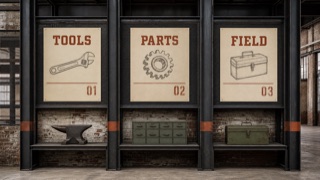
An early-to-mid-1990s style relocating 1940s–60s American clip art, factory printing, and paper-sample graphics into new interiors and graphic systems. It is heavier than Factory Pomo, pairing old labor imagery with rusted beams, mesh, brick, and rough paper.
| Factory Pomo | Industrial Americana | |
|---|---|---|
| Era | late 1980s–early 1990s | early–mid-1990s |
| Family | Industrial and Spatial Design | Industrial and Spatial Design |
| Kind | Style | Style |
| Cues | Gears, bolts, beams, and arrows reduced to geometry / Black and safety yellow expanded with red, blue, and turquoise / CAD-perfect circles and diagonals over old factory lettering / Exposed structure converted into decorative repetition | Vintage line art of tools, workers, factories, and transport / Rust, soot black, ecru, and muted green / Heavy slab serifs, wood type, and stencil numbers / Exposed steel, mesh, concrete, and brick |
| Best used for | Turning factory signs into optimistic information-age symbols in retail or exhibitions · Showing early CAD’s influence across furniture, signage, and print | Giving tool, clothing, or food brands industrial weight across paper and space · Distinguishing 1990s adaptive-industrial design from later cafe décor |
| Type | Combine stencil and geometric type; use numbers and arrows as structural lines. | Set large slab-serif names and stencil numbers, adding old line art like a product label. |
| Composition | Build on horizontal and vertical beams, then collide one circle with one 45-degree line. | Treat beams and rules as one grid and place each image or product in a large rectangle. |
| Material | Finish painted steel, perforated metal, rubber, and plywood in clean bright spot colors. | Combine rough stock, black ink, rust color, mesh, steel, and brick; avoid uniform digital distress. |
| Caution | Rust and bare bulbs drift into later industrial interiors. Factory Pomo updates industrial quotation through bright CAD geometry and postmodern color. | Bare bulbs and brick alone are contemporary industrial décor. The 1990s print language, American factory imagery, and spatial materials need one identification system. |