Eco-Beige vs Global Village Coffeehouse
エコ・ベージュ / グローバル・ヴィレッジ・コーヒーハウス
Eco-Beige comes from Furniture and Interiors and Global Village Coffeehouse from Illustration Styles. They are reached for with some of the same intent, which is where they get confused.
Eco-Beige
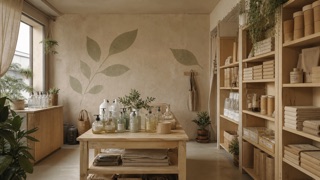
An early-1990s consumer aesthetic that turns away from 1980s gloss through unbleached cloth, branches, pale wood, earth walls, and natural color. It is less raw nature than a staged appearance of restraint and environmental virtue.
Global Village Coffeehouse

A commercial aesthetic combining early-internet global-village optimism with coffeehouse culture, environmentalism, and hand-drawn revival. Woodcut-like suns, hands, eyes, globes, and steam present technology as communal and human.
| Eco-Beige | Global Village Coffeehouse | |
|---|---|---|
| Era | late 1980s–mid-1990s | late 1980s–mid-1990s |
| Family | Furniture and Interiors | Illustration Styles |
| Kind | Style | Style |
| Cues | Low-saturation ecru, sand, and pale gray-green / Linen, raffia, branches, pale wood, and rough plaster / Small serif type and widely spaced labels / Quiet product photography arranging plants and craft materials | Woodcut-like suns, moons, hands, eyes, globes, and coffee cups / Hand-drawn spirals connecting steam, waves, and plants / Blue, violet, and orange airbrush color over earth tones / Irregular borders with naive serif or handwritten type |
| Best used for | Food, cosmetics, and household goods needing the historical feel of early environmental branding · Reconstructed early-1990s retail and residential advertising | Cafe, natural-food, and community promotion evoking 1990s social warmth · Exhibitions about a period when the early internet was described as connection rather than infrastructure |
| Type | Use a small oldstyle serif or humanist sans with wide tracking and short lines. | Use a naive serif or rounded handwriting in short phrases, matching the line quality of the images. |
| Composition | Leave the center open, line up a few material samples low in the frame, and move explanation into the margins. | Expand spirals and plants from a central globe or cup, closing the frame like a single print. |
| Material | Use unbleached cloth, raffia, pale timber, rough paper, and earth-colored plaster without gloss. | Layer woodcut lines, paper fiber, and airbrushed color, but do not borrow culture-specific symbols without provenance. |
| Caution | Beige alone becomes contemporary minimalist packaging. Include period-specific natural materials, craft signals, and staged product photography. | Mixing indiscriminate ethnic symbols turns community ideals into cultural consumption. Return unverified imagery to general forms such as sun, hand, and plant. |