Earthwork / Land Art vs Mono-ha
アースワーク/ランドアート / もの派
Earthwork / Land Art comes from Postwar American Art and Mono-ha from Modern and Contemporary Art Movements. They are reached for with some of the same intent, which is where they get confused.
Earthwork / Land Art

Shapes the landscape itself with earth, stone, branches, terrain and machinery, folding place, time, erosion and documentation into the work.
Mono-ha
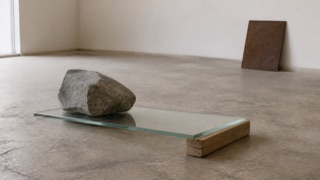
A Japanese tendency that placed stone, wood, glass, steel, and cotton with minimal transformation to expose relations among things, site, support, fracture, and gravity rather than constructing a finished shape.
| Earthwork / Land Art | Mono-ha | |
|---|---|---|
| Era | late 1960s–1970s | late 1960s–1970s |
| Family | Postwar American Art | Modern and Contemporary Art Movements |
| Kind | Style | Style |
| Cues | Intervention in terrain / Earth and stone / Vast scale / Erosion and time | Natural and industrial matter placed in pairs or small groups / Visible cutting, support, pressure, and gravity / Floor and wall contact replacing a strong pedestal / Largely unprocessed stone, steel, wood, cotton, and glass |
| Best used for | Large sites where the character of a place must be shown without erecting a building · Outdoor permanent works that assume weather and erosion will change their shape | Making contact, support, and weight legible instead of using material as a symbol · Letting architecture or product displays hold the boundary between natural and industrial matter |
| Type | Keep lettering off the site and let photographs and drawings explain | Move explanation to the wall and name only the material relation. |
| Composition | Survey levels and sightlines, then compose the work as a route walked | Set distance, contact, and center of mass between two materials and keep walk-around space. |
| Material | Soil, stone and water from the site, with haulage and machinery planned in | Use stone, steel plate, wood, cotton, or glass without cosmetic finishing, concealing only the safety engineering. |
| Caution | Ask about land ownership, environmental cost, Indigenous places and the power held by the documenting medium. Chasing size without reading geology and drainage leaves work that reads as excavation and fails over time. | Placing a stone is not enough. If the relation among material, placement, and site cannot be stated, it becomes display rather than Mono-ha. |
Postwar American Art / Modern and Contemporary Art Movements