Early Cyber vs Silicon Dreams
アーリー・サイバー / シリコン・ドリームズ
Both sit in Digital Retro, so the question is not what they belong to but how they behave. They are reached for with some of the same intent, which is where they get confused.
Early Cyber
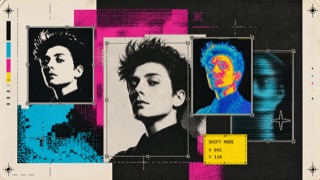
A visual language exposing the first shock of Macintosh and desktop publishing tools freely distorting text, photographs, thermal images, and pixels. Discovery matters more than finish, leaving screen and print boundaries visibly unstable.
Silicon Dreams
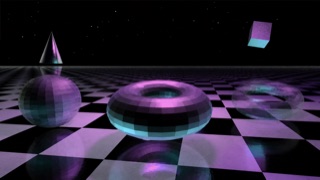
A surreal early-3D language in which transformation itself appears as discovery. Mirrored primitives, low polygon counts, infinite floors, morphing, and floating cameras create a space where the computer seems to dream.
| Early Cyber | Silicon Dreams | |
|---|---|---|
| Era | late 1980s–early 1990s | late 1980s–late 1990s |
| Family | Digital Retro | Digital Retro |
| Kind | Style | Style |
| Cues | Coarse bitmap, thermal, and low-resolution portraits / Stretched, inverted, or bitmapped type / Irregular windows, tools, coordinates, and cursor fragments / Fluorescent color over monochrome early-DTP experiments | Spheres, cones, tori, and faces morphing continuously / Mirrors, checker floors, endless horizons, and black space / Low polygons sharing a frame with smooth reflections / A floating camera circling objects without a destination |
| Best used for | Exhibitions showing the arrival of DTP and personal computing with its original disorder intact · Music and technology promotion that reconstructs digital experimentation before it became polished | Recreating the computational wonder of early 3D in film, games, or technology exhibitions · Presenting technology as a continuously changing dream rather than realistic explanation |
| Type | Mix bitmap and early digital faces, breaking width, direction, or resolution in one place at a time. | Use one simple extruded 3D word and rotate it slowly on the same axis as the object. |
| Composition | Overlap rectangles governed by different rules, retaining UI fragments and print whitespace on one plane. | Morph one central primitive and use the infinite floor and horizon to reveal camera drift. |
| Material | Use 1-bit imagery, coarse scans, color separation, and early CGI at visibly low resolution. | Retain low polygons, mirrors, checker patterns, and coarse early ray-traced reflections instead of polishing them away. |
| Caution | Applying a later glitch filter everywhere loses the specificity of discovering the tools. Constrain transformations to what period hardware and software could produce. | Replacing it with contemporary seamless CGI removes the tool-era difference. Preserve period constraints in polygons, reflections, motion, and rendering. |