Early Cyber vs The New Aesthetic
アーリー・サイバー / ニュー・エステティック
Early Cyber comes from Digital Retro and The New Aesthetic from Digital Culture. One is style and the other aesthetic. They are reached for with some of the same intent, which is where they get confused.
Early Cyber
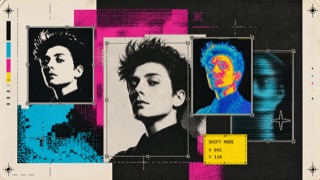
A visual language exposing the first shock of Macintosh and desktop publishing tools freely distorting text, photographs, thermal images, and pixels. Discovery matters more than finish, leaving screen and print boundaries visibly unstable.
The New Aesthetic
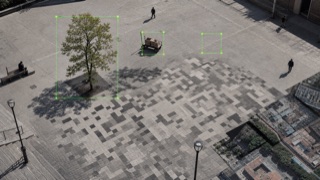
James Bridle's New Aesthetic names the way machine vision and network imagery leak into physical culture through pixels, satellite views, detection boxes and sensor errors.
| Early Cyber | The New Aesthetic | |
|---|---|---|
| Era | late 1980s–early 1990s | 2011– |
| Family | Digital Retro | Digital Culture |
| Kind | Style | Aesthetic |
| Cues | Coarse bitmap, thermal, and low-resolution portraits / Stretched, inverted, or bitmapped type / Irregular windows, tools, coordinates, and cursor fragments / Fluorescent color over monochrome early-DTP experiments | Pixels enlarged onto physical objects / Recognition rectangles and coordinates / Satellite, map and surveillance viewpoints / Compression, omission and machine misclassification |
| Best used for | Exhibitions showing the arrival of DTP and personal computing with its original disorder intact · Music and technology promotion that reconstructs digital experimentation before it became polished | Critically visualizing AI, surveillance and mapping · Showing where human and machine perception diverge |
| Type | Mix bitmap and early digital faces, breaking width, direction, or resolution in one place at a time. | Set coordinates, labels and confidence scores on a separate layer from human explanation. |
| Composition | Overlap rectangles governed by different rules, retaining UI fragments and print whitespace on one plane. | Overlay detection boxes, tracks and map tiles to expose the machine's field of judgment. |
| Material | Use 1-bit imagery, coarse scans, color separation, and early CGI at visibly low resolution. | Leave low resolution, compression and sensor output visibly unresolved. |
| Caution | Applying a later glitch filter everywhere loses the specificity of discovering the tools. Constrain transformations to what period hardware and software could produce. | Pixels and detection boxes used only as futuristic decoration erase the politics of who classifies whom. |