Divine Machinery vs Machine Art
ディヴァイン・マシナリー / マシン・アート
Divine Machinery comes from Post-internet Styles and Machine Art from Modern Design Movements. They are reached for with some of the same intent, which is where they get confused.
Divine Machinery
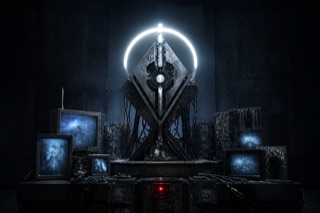
A visual system that connects religious iconography to circuit boards, communications equipment and medical devices, presenting machines not as convenient tools but as objects of awe, ritual and belief. It has a lineage in contemporary art since the 1990s and gained the name Divine Machinery online in the 2020s. Unlike Cyberpunk's city and resistance narratives, it searches for meaning and transcendence in failing technology.
Machine Art
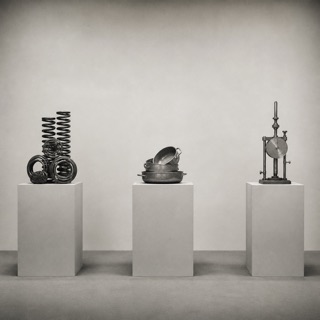
The name of an exhibition the Museum of Modern Art held in New York from March to April 1934. Springs, pots and pans and scientific instruments, all factory made and all utilitarian, were placed on pedestals and treated as sculpture. Philip Johnson screened the walls and ceilings of the museum's nineteenth century brownstone to hide its mouldings, so that undecorated objects could be seen against nothing.
| Divine Machinery | Machine Art | |
|---|---|---|
| Era | 1990s– / 2020s named revival | 1934 |
| Family | Post-internet Styles | Modern Design Movements |
| Kind | Style | Style |
| Cues | Crucifixes, sacred hearts or saints wired directly to circuit boards, cables and monitors / LED halos, transmission towers, servers or medical devices staged frontally like an altar / Cold white, blue and warning red punctuating a dark space while glitches and signal loss remain visible / Religious symmetry or triptychs overlaid with repeating circuits and terminals | Utilitarian factory parts set out one to a pedestal, spaced apart / Mouldings on walls and ceilings screened over, leaving a background with no pattern in it / The objects are springs, pans and instruments, things never made to be looked at / Manufacturers' names standing where an artist's name would normally go |
| Best used for | Questioning AI, surveillance, medicine or communications as objects of trust and awe rather than efficiency · Joining ritual composition to broken devices in music artwork or editorial graphics about religion and technology | Shooting a set of parts or tools by stripping every pattern out of the background and the fixtures and giving each object its own plinth · Selling an undecorated product on a page that leads with the form alone and holds the feature copy back |
| Type | Use one inscriptional serif or terminal monospace, placing prayers and error codes at the same level. | Only the object's name and its maker, small, in one undecorated face. No adjectives. |
| Composition | Center one sacred sign and wire boards, cables and screens into an altar-like symmetry or triptych. | One plinth per object, evenly spaced, with nothing added to the background plane. Cover over any trim or moulding rather than working around it. |
| Material | Start with black metal, old circuit boards, clouded glass and cold-white LEDs; light one warning-red point only. | Metal, glass and porcelain as they come from the factory. No paint and no pattern, so that tooling marks and sheen are all there is to see. |
| Caution | A crucifix beside a cable is only juxtaposition. Define which system mediates access to truth or salvation, and do not use a living faith merely as a prop for strangeness. | Assuming the work is done once the objects are undecorated leaves the room and the fixtures decorated, and the forms lose to the pattern around them. |