Deconstructivism vs Fashion Deconstruction
脱構築主義 / ファッションの脱構築
Deconstructivism comes from Avant-garde and Fashion Deconstruction from Fashion History. They are reached for with some of the same intent, which is where they get confused.
Deconstructivism


Dismantles an achieved order and makes tension and instability the new structure.
Fashion Deconstruction
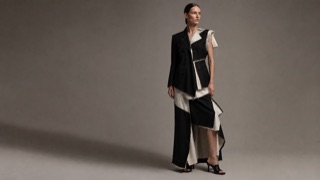
Exposes seam allowance, lining, raw edge, pattern and asymmetric joining instead of hiding clothing as a seamless whole. It does not merely destroy; it dismantles conventions and builds a different body from their parts.
| Deconstructivism | Fashion Deconstruction | |
|---|---|---|
| Era | 1980s– | 1980s– |
| Family | Avant-garde | Fashion History |
| Kind | Style | Style |
| Cues | Fragmentation / Tilt / Colliding layers / Unstable contours | Seam allowances and lining turned outward / Raw edges and deliberate fraying / Asymmetric joins and displaced balance / Patterns and interfacing treated as finished surfaces |
| Best used for | Communicating change or rupture itself · Strong concepts in fashion and architecture | Collections where garment structure and making are the subject · Clothes and displays that value assembly and repair traces over polished finish |
| Type | Sever, duplicate and rotate the letters | Leave labels, basting thread and pattern notation visible as part of the structure. |
| Composition | Collide multiple grids | Break symmetry so joins and excess cloth draw another contour around the body. |
| Material | Translucent layers, cut surfaces, noise | Expose lining, interfacing, seams and cut edges so the order of assembly can be read. |
| Caution | Too heavy a cognitive load for interfaces. Keep experiments to heroes and set pieces. | Torn and frayed cloth alone is not deconstruction. The viewer must see what convention was dismantled and what replaced it. |