Corporate Cyberspace vs Early Cyber
コーポレート・サイバースペース / アーリー・サイバー
Both sit in Digital Retro, so the question is not what they belong to but how they behave. They are reached for with some of the same intent, which is where they get confused.
Corporate Cyberspace
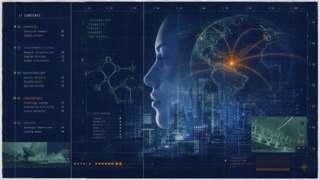
A 1990s commercial style that places the novelty of DTP, telecom, biotech, and multimedia between experimental typography and corporate order. Distortion and transparency appear without destroying the information structure.
Early Cyber

A visual language exposing the first shock of Macintosh and desktop publishing tools freely distorting text, photographs, thermal images, and pixels. Discovery matters more than finish, leaving screen and print boundaries visibly unstable.
| Corporate Cyberspace | Early Cyber | |
|---|---|---|
| Era | early–late 1990s | late 1980s–early 1990s |
| Family | Digital Retro | Digital Retro |
| Kind | Style | Style |
| Cues | Thin sans-serif type stretched, blurred, or made translucent / Digital collages of people, circuits, molecules, and cities / Blue-violet, green, and orange glowing on dark grounds / Corporate order retained through hairlines, numbers, and coordinates | Coarse bitmap, thermal, and low-resolution portraits / Stretched, inverted, or bitmapped type / Irregular windows, tools, coordinates, and cursor fragments / Fluorescent color over monochrome early-DTP experiments |
| Best used for | Historical presentations of telecom, research, or software as period visions of the future · Anniversary publications and films that need a specific 1990s digital optimism | Exhibitions showing the arrival of DTP and personal computing with its original disorder intact · Music and technology promotion that reconstructs digital experimentation before it became polished |
| Type | Use a thin humanist sans and alter underline, width, or opacity only in selected places. | Mix bitmap and early digital faces, breaking width, direction, or resolution in one place at a time. |
| Composition | Retain a grid while layering photographs and text in only two or three translucent planes. | Overlap rectangles governed by different rules, retaining UI fragments and print whitespace on one plane. |
| Material | Combine scans, early CGI, blurred photography, and fine vector lines without erasing low-resolution boundaries. | Use 1-bit imagery, coarse scans, color separation, and early CGI at visibly low resolution. |
| Caution | Glitching the whole surface removes its corporate restraint and drifts toward Early Cyber or rave flyers. Separate the broken layer from the readable one. | Applying a later glitch filter everywhere loses the specificity of discovering the tools. Constrain transformations to what period hardware and software could produce. |