Constructivism vs Neue Slowenische Kunst
構成主義 / ノイエ・スロヴェニッシェ・クンスト
Constructivism comes from Avant-garde and Neue Slowenische Kunst from Modern and Contemporary Art Movements. They are reached for with some of the same intent, which is where they get confused.
Constructivism

%20-%20Liubova%20Popova%20(1889-1924)%20(45056449312).jpg)
Turns a message into motion with diagonals and hard contrast.
Neue Slowenische Kunst
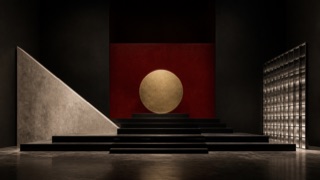
A Slovenian collective in former Yugoslavia whose music, painting, theater, and state-like documents critically reenacted totalitarian, religious, national, and avant-garde signs through over-identification and severe black-red-gold monumentality.
| Constructivism | Neue Slowenische Kunst | |
|---|---|---|
| Era | 1910s–1930s | 1984– |
| Family | Avant-garde | Modern and Contemporary Art Movements |
| Kind | Style | Style |
| Cues | Red, black and white / Diagonal axis / Photomontage / Imperative lettering | Monumental symmetry in black, red, and gold / Eagles, crosses, gears, mountains, and flags as power emblems / Quotation of classical painting, Socialist Realism, and avant-garde imagery / Industrial music, uniform, manifesto, and state documents as one total work |
| Best used for | Campaigns that demand action · Delivering a strong statement in an instant | Critiquing power by over-performing its visual language instead of simply standing outside it · Uniting music, stage, graphics, and exhibition as a fictional institution |
| Type | Heavy condensed type in capitals | Separate monumental serif capitals from small bureaucratic document type. |
| Composition | Collide photography and type along a diagonal spine | Place emblem and figure on a central axis, tightening authority with symmetrical frame, flags, and dark space. |
| Material | Coarse halftones, cut-out photos, three colors only | Use black cloth, metal, oil-paint-like print, red flags, and matte gold with substantial weight. |
| Caution | Carries strong propaganda associations. Check the ethics of context and message. | Do not use totalitarian signs as unexplained decoration. Cite every source and state the former Yugoslav and over-identification contexts. |