Conceptual Art vs Guerrilla Television
コンセプチュアル・アート / ゲリラ・テレビジョン
Conceptual Art comes from Postwar American Art and Guerrilla Television from Experimental Film. They are reached for with some of the same intent, which is where they get confused.
Conceptual Art

.jpg)

Puts the idea at the center of the work and presents it through words, definitions, rules, documentation and placement, caring little for finish as an object.
Guerrilla Television
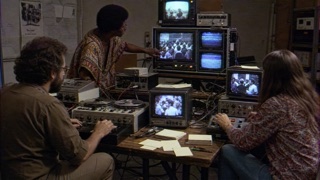
A media movement in which small collectives used portable video to oppose broadcast authority and one-way communication, recording demonstrations, communities, and institutions for rapid editing and alternative circulation. Low resolution, handheld access, feedback, direct titles, and multiple viewpoints became its language.
| Conceptual Art | Guerrilla Television | |
|---|---|---|
| Era | mid-1960s–1970s | late 1960s–1980s |
| Family | Postwar American Art | Experimental Film |
| Kind | Style | Style |
| Cues | Words and definitions / Instructions and rules / Documentary photographs / Dematerialization | Low-resolution portable video, trails, clipping, and dropouts / Long handheld records embedded in events / Handwritten cards, coarse electronic type, and direct time or place labels / Split screens, feedback, and reshooting that dismantle broadcast images |
| Best used for | Exhibitions or research presentations that show procedure and definition instead of a finished object · Participatory projects where published rules let other people carry out the work | Making viewpoint and production process visible in civic media · Composing several field records with electronic titles and transmission traces |
| Type | Plain office grade type presenting the definition exactly as written | State place, time, and speaker with coarse electronic type or cards; never borrow a station identity to fake authority. |
| Composition | Set work beside statement and order everything by the record, not by drama | Keep field footage primary and use split screen, reshooting, or feedback only to expose conflicting viewpoints. |
| Material | Cheap carriers such as photostats, typescript, index cards and wall writing | Retain portable-video resolution, location sound, and tape loss instead of applying one uniform malfunction filter. |
| Caution | Styling the surface to look administrative without a rule or question anyone can test leaves only curt graphic design. Change what counts as the work, including structure, site and the relation to the audience. | VHS noise alone does not create counter-media. Name the makers, community, circulation, and consent, and do not imitate real stations or emergency broadcasts. |