Blob World vs DeepDream
ブロブ・ワールド / ディープドリーム
Both sit in Digital Art, so the question is not what they belong to but how they behave. One is style and the other technique. They are reached for with some of the same intent, which is where they get confused.
Blob World
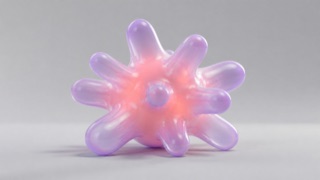
A 3D illustration and motion style built from meticulously rendered soft masses, membranes, hair, and fluids. It makes tactility legible before object identity, placing corporate and music imagery between playfulness and unease.
DeepDream

Google's visualization technique repeatedly amplifies features learned by an image-recognition network, making eyes, animals and towers emerge excessively from clouds, rocks and leaves until misrecognition becomes a recursive hallucinatory surface.
| Blob World | DeepDream | |
|---|---|---|
| Era | mid-2010s– | 2015– |
| Family | Digital Art | Digital Art |
| Kind | Style | Technique |
| Cues | Rounded 3D masses with no obvious function / Overstated wet, furry, translucent, or rubbery surfaces / Holes, folds, and protrusions that suggest bodies / A central form slowly deforming in an empty space | Eyes and animal faces repeated across the frame / Swirling texture multiplying along source contours / Multi-scale repetition that reveals new figures when viewed closer / Saturated blue, yellow and violet rolling continuously |
| Best used for | Short films that communicate material technology or sound without explanatory diagrams · Brand motion that needs a biological focal point balancing charm and discomfort | Exhibits and critical images that make machine misrecognition immediately visible · Music video and cover imagery that keeps a source landscape beneath a multi-scale hallucination |
| Type | Keep small neutral sans-serif text fixed; do not make the lettering mimic the deforming object. | Add type after processing, keeping it short, bold and simple enough not to fight the detail. |
| Composition | Place one mass centrally or crop it at an edge, using empty space to reveal outline and motion. | Preserve the source's large composition and amplify related features at several scales to create recursion into depth. |
| Material | Choose one physical system per object—subsurface scattering, viscosity, hair, membrane, or soft-body deformation—and separate it with light. | Choose layers in a trained vision model and iteratively increase their activation through gradient ascent. |
| Caution | A collection of rounded 3D forms is generic CG. Define each object's resistance, weight, and deformation rules instead of mixing unrelated effects. | It is not a swirl filter or pasted dog faces. Preserve which layer and feature were amplified and how they bind to the source. |