Bauhaus vs Modernist Exhibition Design
バウハウス / モダニズム展示デザイン
Bauhaus comes from Functionalism and Modernist Exhibition Design from Exhibition Design. They are reached for with some of the same intent, which is where they get confused.
Bauhaus


Makes function and play coexist through the circle, triangle and square.
Modernist Exhibition Design
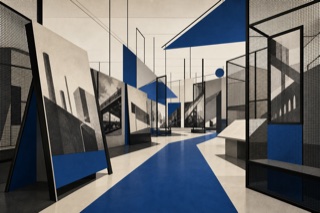
The modernist movement that designed the exhibition as printed matter you walk through. Lissitzky's dynamic installations and Bayer's extended field of vision invented display as an information space that edits the visitor's path and gaze.
| Bauhaus | Modernist Exhibition Design | |
|---|---|---|
| Era | 1919–1933 | 1920s–1940s |
| Family | Functionalism | Exhibition Design |
| Kind | Style | Style |
| Cues | Elementary shapes / Primary colors / Functional beauty / Visible structure | Choreographed circulation / Tilted panels / Photography at giant scale / Compositions wrapping the field of view |
| Best used for | Giving an idea a clear, legible form · Bringing intelligence and warmth to education and culture | Letting the walking order carry the argument in a document heavy exhibition · Building a persuasive display led by photographs and diagrams |
| Type | Geometric sans-serif | Headlines scaled to the wall, body text only where visitors stop |
| Composition | Treat shapes and letters as the same building blocks | Tilt panels and use floor and ceiling to wrap the field of view |
| Material | Red, blue and yellow held together by black and off-white | Enlarged photographs, temporary metal or mesh frames, movable panels |
| Caution | Scattered shapes read as childish. Give every element a job. | Borrowing tilted panels and giant photographs without fixing the order of movement breaks the argument, and the show ends as a busy room. |