Art Nouveau vs Gay Nineties Revival
アール・ヌーヴォー / ゲイ・ナインティーズ・リバイバル
Both sit in Historical Styles, so the question is not what they belong to but how they behave. They are reached for with some of the same intent, which is where they get confused.
Art Nouveau


Joins letters, figures and ornament into one flowing, plant-like line.
Gay Nineties Revival
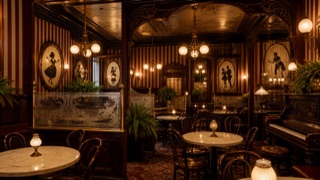
A late-1960s and 1970s revival of 1890s shops, rooms, and lettering as warm popular nostalgia. It is warmer than historical Victorian design, gathering brass, medium-dark wood, ferns, faux Tiffany glass, and old-fashioned lettering around food and entertainment.
| Art Nouveau | Gay Nineties Revival | |
|---|---|---|
| Era | 1890s–1910s | late 1960s–late 1970s |
| Family | Historical Styles | Historical Styles |
| Kind | Style | Style |
| Cues | Botanical curves / Ornamental frames / Female figures / Muted natural colors | Brown, orange, antique gold, maroon, and pale lime / Oak, brass, colored glass, and indoor ferns / Heavy rounded serifs, swashes, and curved sign lettering / Theatrical saloons, sweet shops, and entertainment venues |
| Best used for | Speaking of craft and handwork · Leading with beauty and narrative | Giving hospitality or confectionery the approachable 1970s idea of the 1890s · Comparing a revival’s warm commercial editing with its Victorian source |
| Type | Curvilinear serifs or hand lettering | Use a rounded heavy serif and curved swashes for the short shop name, then return body copy to a small oldstyle face. |
| Composition | Vertical formats, frame compositions, a central figure | Gather signs, lamps, and plants around the entrance and repeat warm focal points inward. |
| Material | Dusty greens and gold, line work, paper texture | Use medium oak, brass, colored glass, and velvet while retaining a newly made 1970s finish. |
| Caution | Stock vine ornaments stay superficial. Carry the line through the whole composition. | Indiscriminate Victorian props become a period set. Make the revival’s warm color, heavy type, and hospitable commercial use explicit. |