Abstract Expressionism vs Gutai
抽象表現主義 / 具体美術協会
Abstract Expressionism comes from Postwar American Art and Gutai from Japanese Postwar Avant-garde. They are reached for with some of the same intent, which is where they get confused.
Abstract Expressionism
%20-%20Franz%20Kline%20(1910-1962)%20(31087622617).jpg)
On huge canvases, with bodily strokes, drips, stains and broad fields of color, what stays on the surface is the act of painting and strong inner feeling rather than a depicted subject.
Gutai
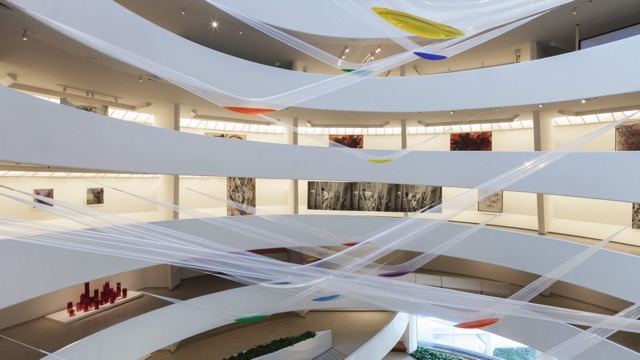


Acts directly on body, mud, paper, water, smoke and light bulbs, making the work an event in which spirit does not master material and each exposes the nature of the other.
| Abstract Expressionism | Gutai | |
|---|---|---|
| Era | 1940s–1950s | 1954–1972 |
| Family | Postwar American Art | Japanese Postwar Avant-garde |
| Kind | Style | Style |
| Cues | Vast canvases / Bodily brushwork / All-over composition / Drips and stains | Body colliding with material / Outdoor exhibitions / Tearing, throwing, treading / Participation and play |
| Best used for | Key visuals for concerts and theatre where emotional intensity has to arrive first · Book covers where one huge abstract ground carries the title alone | Public making and performance where the process and its traces are what is shown. · Outdoor or temporary shows that let the audience feel material meeting body. |
| Type | Keep words to a few and place them clear of the paint | Keep records to date and act described, adding no meaning through a title. |
| Composition | Refuse a center and carry stroke density to every edge | Put the work outdoors or in a passage, letting viewers set their distance. |
| Material | Thick paint and poured washes on a large support, drips left visible | Mud, paper, water, bulbs and paint, keeping the marks of tearing and treading. |
| Caution | Scattering energetic strokes as decoration skips each artist's method, the postwar politics and the tie between scale and body, and with neither density nor a record of decisions it reads as a dirty backdrop. | Restaging the physical gesture without responding to what the material does leaves only spectacle. Read the thought behind it, postwar Japan, the autonomy of material and the audience taking part. |