Punk Fashion vs Rad Dog / Neon Surf
パンク・ファッション / ラッド・ドッグ/ネオン・サーフ
Both sit in Subculture Style, so the question is not what they belong to but how they behave. They are reached for with some of the same intent, which is where they get confused.
Punk Fashion

Punk fashion grew from 1970s music, shops and street culture, cutting, fastening and rewriting ready-made clothing into a confrontational message that included body and hair. DIY alteration, restraint hardware, metal and slogans made dress an editable medium rather than a finished commodity.
Rad Dog / Neon Surf
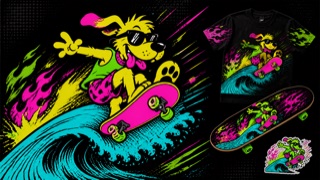
A late-1980s and early-1990s surf, skate, youth-apparel, and equipment style gathering fluorescent splatter, cartoon animals, waves, distorted type, and extreme Hypercolor. It prioritizes speed, mischief, and shelf visibility over natural ocean color.
| Punk Fashion | Rad Dog / Neon Surf | |
|---|---|---|
| Era | mid-1970s– | late 1980s–early 1990s |
| Family | Subculture Style | Subculture Style |
| Kind | Style | Style |
| Cues | Torn T-shirts with exposed seams and fasteners / Safety pins, chains, zips and bondage hardware / Handwritten slogans, band names and repurposed insignia / Upright hair, hard makeup and body piercings | Fluorescent pink, lime, and cyan splatter on black or white / Cartoon animals, waves, boards, teeth, and flames / Heavy slanted lettering with multiple outline, shadow, and scratch layers / One mascot repeated across shirts, boards, stickers, and equipment |
| Best used for | Making an editable sign of belonging and opposition for music, protest or club settings · Reversing the meaning of ready-made clothes, uniforms and insignia by cutting, joining and overwriting them | Reconstructing mischievous late-1980s surf, skate, BMX, or game promotion · Extending one fictional mascot and lettering system across clothing, boards, and stickers |
| Type | Cut existing logos and newspaper lettering into handwritten words and uneven joins. Name the target of a slogan rather than substituting generic rebellion. | Draw a short fictional name in a forward-slanted heavy face and offset a bright outline and black shadow in different directions. |
| Composition | Concentrate tears, metal and text in one part of the body and support it with worn utility clothing. Design hair and posture as part of the full silhouette. | Crop one fictional mascot at center, drive a wave or splatter along a diagonal, and leave the corners open. |
| Material | Cut, pin and resew secondhand cotton, leather and tartan with metal and permanent ink. Keep dangerous hardware off skin and verify wear safety. | Use screen-print-like fluorescent flats, coarse halftone, vinyl stickers, and painted boards with one shared color separation. |
| Caution | A new set of safety pins, tartan and a mohawk becomes costume. Separate it from Punk graphics and retain who objects to what and how the wearer altered the garment. | Do not use Indigenous or Pacific forms historically marketed as tribal without provenance. Build from fictional animals, waves, splatter, and speed lines, and never imitate an existing brand mascot. |