Post-Impressionism vs Progressive Artists' Group
ポスト印象主義 / プログレッシヴ・アーティスツ・グループ
Post-Impressionism comes from Painting Techniques and Progressive Artists' Group from Modern and Contemporary Art Movements. They are reached for with some of the same intent, which is where they get confused.
Post-Impressionism


.jpg)
A collective name for painters who found the improvisation of Impressionism insufficient and recovered structure, symbol and emotion, each in their own way. It is not one style but several answers standing side by side, among them pointillism, flat fields of color and surging brushwork. Twentieth century abstraction branched off from here.
Progressive Artists' Group
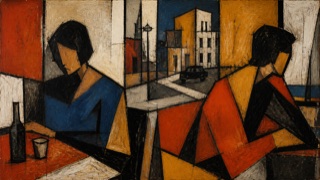
A post-independence Bombay group that rejected both colonial academism and nationalist revival, individually recombining Cubism, Expressionism, Indian cities, and religious imagery through strong color fields and distorted figuration.
| Post-Impressionism | Progressive Artists' Group | |
|---|---|---|
| Era | 1880s–1900s | 1947–1956 |
| Family | Painting Techniques | Modern and Contemporary Art Movements |
| Kind | Style | Style |
| Cues | A constructed order of brushstrokes / Flat, forceful fields of color / Undulating line that carries emotion / Inquiry into form ahead of subject | Divided and simplified figures, villages, and cities / High contrast among red, orange, blue, and black / Folk or sacred imagery beside European modernist devices / Heavy contour, flat field, and rough surface together |
| Best used for | Showing in a single image what happened after Impressionism · Comparing cases where one subject was solved by different methods | Showing how several modernisms collide with regional subjects rather than forming one smooth style · Representing post-independence urban and religious plurality without reducing it to a national motif |
| Type | Change the typeface with each manner and do not aim for uniformity. | Name the work and artist instead of unifying the group with pan-Indian display type. |
| Composition | Give priority to building planes and break perspective on purpose. | Divide the figure or city into flat fields and retain tension through strong contours. |
| Material | Thick paint, with the borders between fields of color left visible. | Layer opaque red, ochre, blue, and black on rough canvas, preserving drawing and abrasion. |
| Caution | Do not treat it as a single style. Name each time whose solution you mean. | Do not freeze the group into one look. State differences among artists, Bombay's place, and the politics after independence. |