Pixel Art vs Winamp Skin
ピクセルアート / Winampスキン
Pixel Art comes from Digital Image Techniques and Winamp Skin from Digital Retro. One is technique and the other style. They are reached for with some of the same intent, which is where they get confused.
Pixel Art

.gif)
Treats the pixel as an honest unit, building clear form from limited resolution and palette.
Winamp Skin
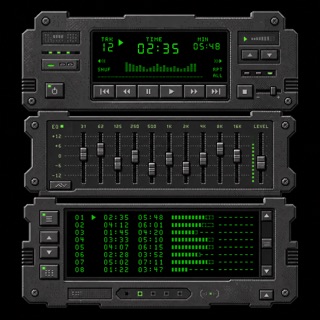
Player faces drawn and passed around by amateurs. The rectangular window frame is thrown away for the front panel of a piece of stereo equipment, and even the digits and letters are drawn as bitmap pictures laid side by side on a single sheet.
| Pixel Art | Winamp Skin | |
|---|---|---|
| Era | 1970s– | 1997–2005 |
| Family | Digital Image Techniques | Digital Retro |
| Kind | Technique | Style |
| Cues | Visible pixels / Limited palettes / Tiles / Sprites | A non rectangular outline that imitates the front panel of a piece of stereo equipment / Digits and letters drawn as tiny monospaced bitmaps laid out on one sheet / Metal reflections and glowing displays built by placing dots rather than by tonal gradation / Three windows, player, equalizer and playlist, snapping together into one upright device |
| Best used for | Icons and controls for small screens that stay clean when scaled up · Game characters and terrain that must read apart at tiny sizes | Rebuilding the feel of late 1990s desktop culture inside a screen for an exhibit or a video · Designing a theming mechanism where a user swaps nothing but a folder of bitmaps |
| Type | Draw letters on the same grid, fixing cap height in pixels | Draw letters as bitmaps rather than setting type. Lay digits and letters out at fixed width on one sheet and blit only the glyphs you need. |
| Composition | Scale only by whole multiples and keep every element on grid | Freeze the coordinates of every control and change only the artwork. Split the interface into role specific windows and cut each silhouette from the transparency of a single image. |
| Material | Limited palette, dark outlines, neighboring hues to soften the steps | Work in a small palette at one to one pixel scale with no resampling. Render both metal reflection and glowing readouts purely by how the dots are arranged. |
| Caution | Downscaling a photograph skips the decision behind every single pixel, and the contours turn muddy the moment the image is enlarged. | Because the coordinates are fixed, the louder the artwork gets the more the controls sink into it, so check the contrast between decoration and operable surface after the art is done. |