Photorealism vs Tableau Photography
フォトリアリズム / タブロー写真
Photorealism comes from Postwar American Art and Tableau Photography from Photography Movements. They are reached for with different intent, which is the fastest way to tell them apart.
Photorealism


A movement that transfers the photograph itself onto the canvas, rebuilding by hand the quantity of information a mechanical eye records. Shop-window reflections, the warp of chrome, diner neon: the subject is fixed on the surface together with the photograph's own focus, grain and chromatic fringing. What is painted is not what was seen but the fact that a camera saw it that way.
Tableau Photography
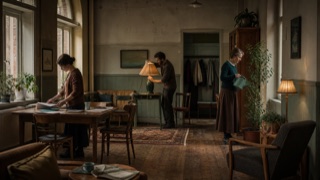
Assembles the scene before the shutter and holds it in a single print made to hang like a painting, its figures acting as if no viewer were there.
| Photorealism | Tableau Photography | |
|---|---|---|
| Era | 1968–1980s | 1970s |
| Family | Postwar American Art | Photography Movements |
| Kind | Style | Style |
| Cues | Reflections and highlights taken from the photograph / Depth of field painted exactly as the lens gave it / Commercial subjects drawn from the city / A smooth surface with every brushmark erased | A single large print made to hang / Figures who never look back at you / Interiors and streets built to the last corner / Lighting borrowed from cinema |
| Best used for | Advertising for cars and watches where the reflections in chrome and glass are the subject · Books and features on the city and consumer culture that keep the information a mechanical eye records | Restaging the conventions of advertising or news images to cast doubt on them · Building a story into one frame meant for exhibition, not for record |
| Type | Let lettering appear inside the frame as signage, never laid over the image from outside | Make the text in the frame as a prop rather than borrowing a typeface |
| Composition | Keep the photograph's own crop and do not recompose the frame | Fix gaze and hand positions in advance and block the frame like a painting |
| Material | Paint grain and fringing into a surface smoothed of every brushmark, letting no substrate texture show | Built sets or models, cinematic lighting, large format shot and printed big |
| Caution | Cleaning up the lens artefacts: polish out the focus fall-off, the grain and the fringing and the picture stops reading as a photograph made by hand, leaving airless illustration. | Staging that only imitates a natural record leaves the assumption that photographs record reality untouched, and the whole reason for constructing the scene disappears. |