Photorealism vs Stuckism
フォトリアリズム / スタッキズム
Photorealism comes from Postwar American Art and Stuckism from Modern and Contemporary Art Movements. They are reached for with different intent, which is the fastest way to tell them apart.
Photorealism


A movement that transfers the photograph itself onto the canvas, rebuilding by hand the quantity of information a mechanical eye records. Shop-window reflections, the warp of chrome, diner neon: the subject is fixed on the surface together with the photograph's own focus, grain and chromatic fringing. What is painted is not what was seen but the fact that a camera saw it that way.
Stuckism
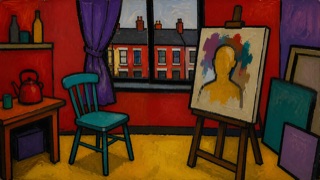
A movement founded in London in 1999 that opposed institutional Conceptual art by advocating figurative painting, manifestos, and public protest, often through self-portraiture, hard contour, flat non-natural color, and narrative rooms or streets.
| Photorealism | Stuckism | |
|---|---|---|
| Era | 1968–1980s | 1999– |
| Family | Postwar American Art | Modern and Contemporary Art Movements |
| Kind | Style | Style |
| Cues | Reflections and highlights taken from the photograph / Depth of field painted exactly as the lens gave it / Commercial subjects drawn from the city / A smooth surface with every brushmark erased | Heavy contours around figures and rooms / Flat, non-natural saturated color / Frontal autobiographical or narrative scenes / Hand-painted signs, manifestos, and public protest |
| Best used for | Advertising for cars and watches where the reflections in chrome and glass are the subject · Books and features on the city and consumer culture that keep the information a mechanical eye records | Introducing a contemporary figurative movement through painting, manifesto, and institutional critique · Prioritizing personal story and strong contour over polish in an exhibition or publication |
| Type | Let lettering appear inside the frame as signage, never laid over the image from outside | Set manifesto copy in a heavy sans-serif outside the work and reserve handwriting for signs within it. |
| Composition | Keep the photograph's own crop and do not recompose the frame | Place figures frontally in shallow space and order outlined objects and color fields by narrative sequence. |
| Material | Paint grain and fringing into a surface smoothed of every brushmark, letting no substrate texture show | Lay opaque acrylic or oil flat, preserving black contour and uneven fill. |
| Caution | Cleaning up the lens artefacts: polish out the focus fall-off, the grain and the fringing and the picture stops reading as a photograph made by hand, leaving airless illustration. | Not all contemporary figurative painting is Stuckism. The 1999 movement, manifesto, and institutional position are the boundary. |
Postwar American Art / Modern and Contemporary Art Movements