Paint-on-Glass Animation vs Sand Animation
ペイント・オン・グラス・アニメーション / 砂アニメーション
Both sit in Animation Techniques, so the question is not what they belong to but how they behave. They are reached for with some of the same intent, which is where they get confused.
Paint-on-Glass Animation
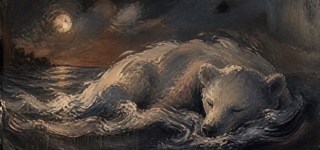
Paint-on-glass animation adds and removes slow-drying paint on one pane beneath a camera. It does not replace one finished drawing with another: brush marks, wiped traces and mixed color accumulate as a continuous history on the same surface.
Sand Animation

Sand animation moves grains across a light table frame by frame. Thickness controls transmitted light from amber to black, and every contour continually breaks apart as its particles become the next image.
| Paint-on-Glass Animation | Sand Animation | |
|---|---|---|
| Era | 1940s– | 1960s– |
| Family | Animation Techniques | Animation Techniques |
| Kind | Technique | Technique |
| Cues | Contours pushed by brush and finger into the next form / The previous image lingering as stains and streaks / Opaque masses beside translucent wiped passages / The whole field transforming fluidly instead of cutting | Transmitted tone ranging from amber to black by sand thickness / Finger-drawn grooves and pushed granular edges / The next image emerging from traces swept out of the last / Uneven particles scattering around contours |
| Best used for | Showing memory or emotional change as transformation within one image · Using painterly marks as time-bearing material in music film rather than as static texture | Telling fable, dream or natural cycle through images that form and vanish in one field · Adding hand-paced granular abstraction to music or spoken narration |
| Type | Keep long copy on a separate layer; if words are painted, reveal and erase them one at a time at the painting's pace. | Draw only short words as broad grooves or density changes, placing longer reading in separate subtitles. |
| Composition | Retain one focal trace while wiping the surroundings into the next scene. Reduce returns to a completely blank frame. | Keep the light table broadly open and gather dark sand at the focus. Choose one part of each image to carry into the next. |
| Material | Put slow-drying oil paint or gouache on glass and add or subtract it with brush, finger and cloth beneath locked camera and light. | Spread even-grained sand thinly over transmitted light, build darkness by depth, and record each move made by finger, brush or card. |
| Caution | Morphing between finished digital paintings is different. Each frame should carry the actual history of wet paint added to and removed from one surface. | Sand-colored noise or footage of a finished sand picture is not the technique. Grain thickness, transmitted light and physical redistribution must form every frame. |