New Wave Tropical vs Tropicália
ニューウェーブ・トロピカル / トロピカリア
New Wave Tropical comes from Illustration Styles and Tropicália from Brazilian Avant-garde. They are reached for with some of the same intent, which is where they get confused.
New Wave Tropical
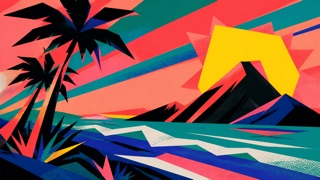
A commercial graphic style adding rainforests, hot color, and irregular cut-paper shapes to the free typography of Pacific Punk Wave. Leaves, birds, waves, and suns become large urban graphic fragments rather than realistic tropical scenes.
Tropicália


Mixes vivid color, music, sand, plants, temporary structures and audience participation to criticize both the repression of military rule and the outsider's image of a 'tropical paradise.'
| New Wave Tropical | Tropicália | |
|---|---|---|
| Era | late 1970s–mid-1990s | mid-1960s– |
| Family | Illustration Styles | Brazilian Avant-garde |
| Kind | Style | Style |
| Cues | Irregular fields resembling hand-cut heavy paper / Oversized leaves, birds, waves, and suns layered flat / High-saturation magenta, turquoise, yellow, green, and black / Slanted sans and hand lines following cut edges | Blazing hybridity / Participatory space / Music and costume / The tropical image inverted |
| Best used for | Giving music, travel, or food promotion urban speed without tropical photography · Critically examining how 1980s commercial graphics borrowed cultural imagery | Music festivals and cultural events that want to celebrate mixture and unruliness · Critical advertising or covers that quote the tropical cliche in order to invert it |
| Type | Set a short slanted sans phrase and align one edge with an irregular cut-paper boundary. | Mix handwriting, sign painting and printed faces, breaking unity on purpose |
| Composition | Crop one large leaf or wave and overlap only three or four differently scaled color fields. | Build paths and places to linger so the audience completes the piece |
| Material | Use matte flat color, rough cut-paper edges, and hand-drawn lines without photographic dimensional shadows. | Sand, raw wood, cloth, temporary boards and primary paint left rough |
| Caution | Do not treat African, Caribbean, or Latin cultural symbols as generic tropical decoration. Verify region and maker and state provenance when using specific imagery. | Reducing it to colorful tropical taste reproduces the tourist paradise it set out to criticize, so the Brazilian military regime, the favelas and the political mixing of music and art have to be read. |