Net.art vs Post-Internet Art
ネット・アート / ポスト・インターネット・アート
Net.art comes from Digital Art and Post-Internet Art from Digital Culture. One is style and the other aesthetic. They are reached for with some of the same intent, which is where they get confused.
Net.art
.jpg)
Treats the browser, the link, the transmission error and the network itself as both the material and the site of the work.
Post-Internet Art
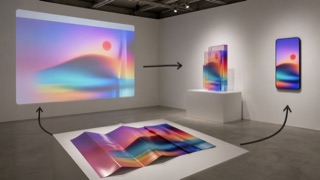
Post-Internet art treats the internet as an ordinary condition of life and production, turning the circulation between online images, objects, exhibitions and documentation into the work.
| Net.art | Post-Internet Art | |
|---|---|---|
| Era | 1990s– | 2000s– |
| Family | Digital Art | Digital Culture |
| Kind | Style | Aesthetic |
| Cues | Link structures / Browser UI / Errors / Participation and transmission | Network images converted into prints or objects / Screenshots, product images and 3D renders mixed / Installation views returning to social feeds / High-resolution and compressed imagery on the same surface |
| Best used for | Publishing work at a URL when it can only exist inside a browser · Making the mechanics of transmission and surveillance the subject itself | Treating social, commerce, 3D and galleries as one circulation system · Tracing digital images into objects and back online |
| Type | Use default browser fonts and leave underlined links undecorated | Let interface text, product names, filenames and gallery labels coexist as distinct registers. |
| Composition | Make navigation the composition, assuming back buttons and several windows | Place browser images, objects and documentation together without declaring one the original. |
| Material | HTML, GIF, error screens and slow loading treated as material | Keep the traces of conversion between screenshot, compression, print, 3D output and commodity. |
| Caution | Reproducing the early web look as a flat image leaves nothing that links, transmits or invites participation, and the network that was the site of the work disappears. | A collage of found web images alone does not address the circulation, reproduction and exhibition that define the tendency. |