Minjung Art vs Social Realism
民衆美術(ミンジュン美術) / ソーシャル・リアリズム
Both sit in Printmaking and Social Movements, so the question is not what they belong to but how they behave. They are reached for with some of the same intent, which is where they get confused.
Minjung Art
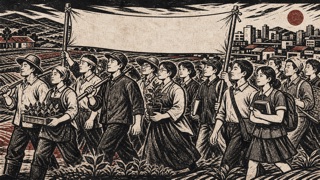
Art of South Korea's democratization era that joined labor, rural life, division, and collective action to woodcuts, banners, murals, hanging pictures, and comic-like public imagery made to circulate beyond the museum.
Social Realism
.jpg)
Social Realism used legible figures, public art, print and photography to expose contemporary labor, poverty, racism, migration and urban conditions. It is distinct from state-prescribed Socialist Realism.
| Minjung Art | Social Realism | |
|---|---|---|
| Era | 1980s–early 1990s | 1920s–1940s |
| Family | Printmaking and Social Movements | Printmaking and Social Movements |
| Kind | Style | Style |
| Cues | Heavy woodcut-like black line / Workers, farmers, and crowds presented frontally / Large public banners, murals, and hanging pictures / Sign-like red, blue, or yellow within folk and comic structures | Workers, unemployed people, migrants and urban crowds centered / Factories, housing and streets making conditions legible / Direct figuration spanning prints, murals and photographs / Individual hardship connected to institutions or collective problems |
| Best used for | Making a demonstration, labor action, or local campaign readable through collective production · Showing East Asian democratization through print and street media as well as individual artists | Communicating labor and inequality publicly through people and environments rather than statistics alone · Translating social critique into legible posters, murals, editorial work or exhibitions |
| Type | Cut a short slogan in the local language and place translation on a separate reading surface. | Use short direct headings plus names, places and dates; do not overwrite a subject's voice with decorative slogans. |
| Composition | Give the crowd one direction and align flags, arms, and tools along the same diagonals. | Put human action forward and connect it to factories, streets, housing and crowds as readable causes and relations. |
| Material | Use large woodcut, cloth, cheap paper, and black ink with one red accent for reproduction and display. | Use the forceful contrast of woodcut, lithograph, mural or grain-bearing photography suited to reproduction and public display. |
| Caution | Do not turn fists and crowds into generic political decoration. Name Korean democratization, labor, division, and collective circulation. | Do not consume labor or poverty as dramatic material. Separate it from the state heroics of Socialist Realism and state who represents whose conditions for what purpose. |