Khartoum School vs Nsukka Group
ハルツーム派 / ンスッカ・グループ
Both sit in Modern and Contemporary Art Movements, so the question is not what they belong to but how they behave. They are reached for with some of the same intent, which is where they get confused.
Khartoum School
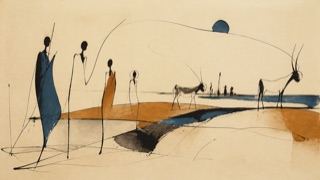
In post-independence Sudan, the fluid and contested Khartoum School recombined African, Islamic, Arab and Western references within modern art. Arabic calligraphic rhythm, simplified people and animals, local craft and narrative moved into abstraction.
Nsukka Group
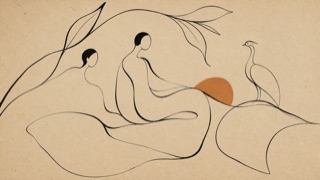
Around the University of Nigeria, Nsukka, Uche Okeke and later artists extended the flowing lines of uli body and wall drawing and signs including nsibidi into contemporary work on paper, print, textile and sculpture. Fine line and open ground carry narrative and abstraction together.
| Khartoum School | Nsukka Group | |
|---|---|---|
| Era | 1960s–1970s | 1970s– |
| Family | Modern and Contemporary Art Movements | Modern and Contemporary Art Movements |
| Kind | Style | Style |
| Cues | Arabic writing transforming into human, animal and abstract contours / Groups of elongated bodies and mask-like faces / Wide space and line in ink, earth color, blue and white / Local craft and story sharing a field with modern painting | Long flowing black lines with changing weight / Large negative shapes and open ground enclosed by line / People, animals and plants compressed into signs / Uli and nsibidi references crossing paper, textile, print and sculpture |
| Best used for | Treating several cultural belongings as transformations of line and figure rather than one fixed emblem · Rereading writing, story, craft and modern painting in relation to post-independence society | Turning land, body and story into contemporary signs through line and open ground · Developing a regional drawing practice across media rather than closing it into one surface pattern |
| Type | When using Arabic, verify word and writer and leave the transition from text to person or animal visible. | Verify Igbo terms and the uses of uli and nsibidi; do not invent a sign string to simulate meaning. |
| Composition | Place elongated forms in groups across broad space, keeping repeated line ambiguous among writing, body and horizon. | Make only a few flowing lines primary and preserve their enclosed negative forms at equal strength. Simplify figures along the line's direction. |
| Material | Keep the absorption of ink, earth pigment, paper and cloth and resist cleaning every edge into a uniform vector line. | Preserve the line quality of ink, pen, dye and print matrix instead of converting it into a uniform stock pattern. Credit community and maker. |
| Caution | It was neither a monolithic look nor one uncontested national identity. Preserve differences among artists and debates around the name instead of generalizing it as African calligraphy. | Repeating uli as an African pattern is not the Nsukka lineage. Show its relation to women's body and wall drawing, its university reinterpretation and differences among artists. |