Hexatron vs Synthwave
ヘキサトロン / シンセウェーブ
Hexatron comes from Visions of the Future and Synthwave from Digital Retro. They are reached for with some of the same intent, which is where they get confused.
Hexatron
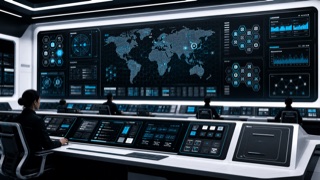
A 2010s future language crystallized around TRON: Legacy, using hexagonal grids, diagonals, blue light, holograms, and terminal-like interfaces. Harder in black and white than Synthwave and cleaner than Cyberpunk, it foregrounds angular technical ornament and complete systems.
Synthwave
.jpg)


Replays the future the 1980s imagined, in neon and horizon lines.
| Hexatron | Synthwave | |
|---|---|---|
| Era | early–late 2010s | 1980s imagined future |
| Family | Visions of the Future | Digital Retro |
| Kind | Style | Style |
| Cues | Hexagons repeated as cells, floors, armor, and controls / Thin blue or cyan light on black or white / Cut-corner panels, diagonals, concentric circles, and terminal numerals / Floating translucent surfaces and particles tied to hands or objects | Neon / Perspective grid / Sunset / Black sky |
| Best used for | Making a precise recognizably 2010s future system for film, games, or event motion · Connecting staged data to real objects and gestures in technology exhibitions | Instant world-building for games and music · The euphoria of retro-futurism |
| Type | Use a narrow angular sans with monospace numerals; keep headings short and units or coordinates small. | Oblique sans with script accents |
| Composition | Do not wallpaper the frame with hexagons; assign the grid only to cells, paths, and focus. | Low horizon, central perspective, gigantic title |
| Material | Separate black surfaces, thin cyan emission, translucent glass, particles, and hard reflections by depth. | Black, magenta, cyan, glow |
| Caution | Using hex panels and ornament for every control makes real interfaces unreadable and hard to touch. Separate the spectacle layer from the control layer and return important data to simple rectangles. | Sun and grid alone are overfamiliar. Add story elements of your own. |