Future Funk vs Staged Photography
フューチャーファンク / 演出写真
Future Funk comes from Digital Retro and Staged Photography from Photographic Genres. One is style and the other technique. They are reached for with some of the same intent, which is where they get confused.
Future Funk
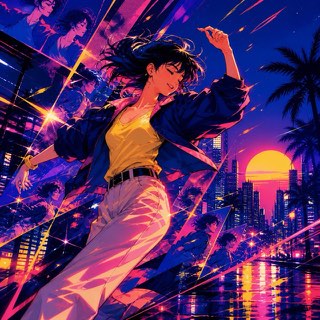
Re-edits 1980s Japanese pop at high speed into dazzling euphoria.
Staged Photography

%20-%20Edward%20Carpenter.jpg)

Composes scene, figure, props and light before the shutter, shaking the very premise that photographs record reality.
| Future Funk | Staged Photography | |
|---|---|---|
| Era | 2010s | 19th century– / 1970s revival |
| Family | Digital Retro | Photographic Genres |
| Kind | Style | Technique |
| Cues | 80s anime / City pop / Vivid night views / Rapid collage | Constructed scenes / Props / Cinematic lighting / Deliberate artificiality |
| Best used for | Instant joy for music and events · A pop rereading of the urban night | Restaging the conventions of advertising or news images to cast doubt on them · Building a story into one frame meant for exhibition, not for record |
| Type | Bold Japanese gothic plus Latin script accents | Make the text in the frame as a prop rather than borrowing a typeface |
| Composition | Layer figures, city and type rhythmically | Fix gaze and hand positions in advance and block the frame like a painting |
| Material | Pink, blue, yellow, VHS grain | Built sets or models, cinematic lighting, large format shot and printed big |
| Caution | Avoid unlicensed anime frames and surface-level consumption of the culture; clear the rights. | Staging that only imitates a natural record leaves the assumption that photographs record reality untouched, and the whole reason for constructing the scene disappears. |