Elastic UI vs Solarized
Elastic UI / ソラライズド
Elastic UI comes from Platform Screen Languages and Solarized from UI Expression. They are reached for with some of the same intent, which is where they get confused.
Elastic UI
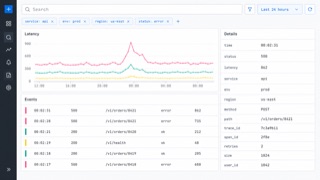
Elastic's interface system is made for searching, filtering and diagnosing large data sets without losing operational density.
Solarized
.png)


Solarized is a sixteen colour scheme for terminal and GUI applications published by Ethan Schoonover with every value in the open, eight monotones and eight accents. The monotones hold symmetric CIELAB lightness differences, so moving between the light and the dark background keeps the same perceived contrast. It lowers brightness contrast on purpose and lets hue relations, not brightness, separate one token from the next.
| Elastic UI | Solarized | |
|---|---|---|
| Era | 2017– | 2011– |
| Family | Platform Screen Languages | UI Expression |
| Kind | Style | Style |
| Cues | Fixed header and left navigation / Persistent query, filter and time controls / Tables and time-series charts in shared panels / Bright series colors limited to data | Backgrounds that are neither pure black nor pure white, one leaning teal and one leaning cream / A small lightness gap between body text and ground, softer than black on white / Eight accents at close to equal lightness, told apart by hue alone / The same accent holding the same role after the background is flipped from dark to light |
| Best used for | Log and security investigation screens · Products that combine query, table, visualization and detail | Giving an editor or terminal one reading feel across both light and dark backgrounds · Separating elements on a screen someone stares at for hours, without raising contrast |
| Type | Separate monospaced values from explanatory sans text and never rely on color alone. | One monospaced face, carrying emphasis in colour rather than in weight or slant. |
| Composition | Give navigation, query, visualization and detail stable regions; keep time and filters visible. | Divide regions by shifting the ground one step instead of drawing rules, and leave the ground generous. |
| Material | Layer neutral surfaces, reserve blue for interaction and bright hues for data series. | Hold to the eight monotones and eight accents, anchoring the ends at #002b36 and #fdf6e3 and taking body text from the middle greys. |
| Caution | More charts do not create more insight. Remove any panel or series that does not answer the current question. | Borrowing only the backgrounds and inventing your own accents breaks the matched CIELAB lightness, and the scheme loses the very mechanism that lets hue do the separating. |