Cyberpunk vs Divine Machinery
サイバーパンク / ディヴァイン・マシナリー
Cyberpunk comes from Visions of the Future and Divine Machinery from Post-internet Styles. They are reached for with some of the same intent, which is where they get confused.
Cyberpunk


Advanced technology and ruined daily life share the same frame, so the future arrives as promise and as threat.
Divine Machinery
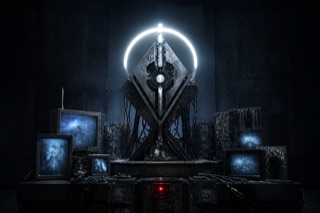
A visual system that connects religious iconography to circuit boards, communications equipment and medical devices, presenting machines not as convenient tools but as objects of awe, ritual and belief. It has a lineage in contemporary art since the 1990s and gained the name Divine Machinery online in the 2020s. Unlike Cyberpunk's city and resistance narratives, it searches for meaning and transcendence in failing technology.
| Cyberpunk | Divine Machinery | |
|---|---|---|
| Era | 1980s– | 1990s– / 2020s named revival |
| Family | Visions of the Future | Post-internet Styles |
| Kind | Style | Style |
| Cues | Rainy nights / Multilingual neon / Dense cabling / Dark cities | Crucifixes, sacred hearts or saints wired directly to circuit boards, cables and monitors / LED halos, transmission towers, servers or medical devices staged frontally like an altar / Cold white, blue and warning red punctuating a dark space while glitches and signal loss remain visible / Religious symmetry or triptychs overlaid with repeating circuits and terminals |
| Best used for | Speaking of technology's light and shadow together · Thick world-building for games and film | Questioning AI, surveillance, medicine or communications as objects of trust and awe rather than efficiency · Joining ritual composition to broken devices in music artwork or editorial graphics about religion and technology |
| Type | Angular sans, monospace, multiple scripts | Use one inscriptional serif or terminal monospace, placing prayers and error codes at the same level. |
| Composition | Stack information densely on dark planes | Center one sacred sign and wire boards, cables and screens into an altar-like symmetry or triptych. |
| Material | Black, teal, red neon, raindrops | Start with black metal, old circuit boards, clouded glass and cold-white LEDs; light one warning-red point only. |
| Caution | Don't use Asian cities as a symbol of otherness. Make the fictional social order concrete. | A crucifix beside a cable is only juxtaposition. Define which system mediates access to truth or salvation, and do not use a living faith merely as a prop for strangeness. |