CDE Interface vs OPEN LOOK
CDEインターフェース / オープンルック
Both sit in Platform Screen Languages, so the question is not what they belong to but how they behave. They are reached for with some of the same intent, which is where they get confused.
CDE Interface
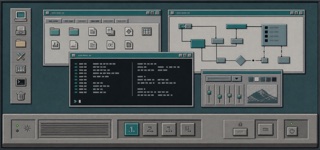
The Common Desktop Environment unified UNIX workstations through Motif-derived bevels, a persistent Front Panel, workspace switching and low-color icons, making different hardware feel like one workplace.
OPEN LOOK


A screen language for Unix workstations, specified by Sun Microsystems in a functional specification published by Addison-Wesley in 1989. The book defines two parallel designs, one black and white for monochrome displays and one three dimensional for grayscale and colour, sets a single sans serif variable width face for every common element, and tells implementers that restraint is the key to colour. Each pop-up window carries a pushpin at the left of its header, and pinning it leaves the window on the workspace.
| CDE Interface | OPEN LOOK | |
|---|---|---|
| Era | 1993–2000s | 1988–1990s |
| Family | Platform Screen Languages | Platform Screen Languages |
| Kind | Style | Style |
| Cues | Box-like Front Panel along the lower edge / Raised buttons and recessed fields made from paired light and dark borders / Low-color pixel icons with dark outlines / Persistent buttons for switching among workspaces | A pushpin at the left end of a pop-up window's header, which pins the window to the workspace instead of dismissing it / Three dots after a label announce a window, an outlined triangle announces a menu / Scrollbars split into an elevator, a cable and top and bottom cable anchors, with the dark part of the cable showing how much is in view / The workspace is a 50 percent dither pattern and menu drop shadows are a 75 percent pattern |
| Best used for | Shipping one desktop and business application language across UNIX workstations · Reconstructing a 1990s technical terminal with its operating structure intact | Rebuilding a Unix workstation screen from around 1990 with a look that reads as Sun rather than Motif · Rebuilding a working screen so it survives a one bit display, using dither patterns and outlines alone |
| Type | Use brief system type and labels that remain distinct at small sizes. | Set every shared element in the same sans serif variable width face. Size in points rather than pixels, and scale through the 10, 12, 14 and 19 point steps the spec provides. |
| Composition | Layer work windows centrally and keep the Front Panel and workspace switch along the lower edge. | Give each window four resize corners and gather commands into control areas outside the pane. Every pop-up window opens with a header that carries a pushpin. |
| Material | Place a light top-left edge and dark bottom-right edge on mid-tone surfaces, reversing the bevel only on press. | Make the design work in black and white first. For the three dimensional version pick one background colour, derive the recessed shade by adding 10 to 15 percent black, and reserve white for lit edges. |
| Caution | Gray bevels alone are not CDE. Front Panel, workspaces and Motif state rules must work as one environment. | Starting from the three dimensional colour scheme collapses the moment the design meets a monochrome display, where neither the raised edges nor the pushpin survive. |