Art Deco vs Deco-Luxe
アール・デコ / デコ・リュクス
Both sit in Historical Styles, so the question is not what they belong to but how they behave. They are reached for with some of the same intent, which is where they get confused.
Art Deco


Stages urban luxury with repeating geometry and a metallic sheen.
Deco-Luxe
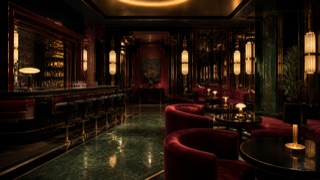
An 1980s revival that reconnects Art Deco and Streamline Moderne with wealth, finance, hotels, and nocturnal consumption. It is darker and glossier than its source period, using metal and mirrors to stage success itself.
| Art Deco | Deco-Luxe | |
|---|---|---|
| Era | 1920s–1930s | early–late 1980s |
| Family | Historical Styles | Historical Styles |
| Kind | Style | Style |
| Cues | Symmetry / Radiating lines / Stepped motifs / Gold and black | Black, deep green, or burgundy with gold and brass / Fans, steps, rays, and streamlines repeated at large scale / Strong reflections from mirror, polished stone, and lacquer / Narrow geometric lettering with wide tracking and symmetry |
| Best used for | Giving an event a sense of occasion · Producing instant classic luxury | Hotels, bars, fragrance, and jewelry identities seeking an explicitly 1980s nocturnal luxury · Exhibitions comparing the Deco revival with its historical source |
| Type | Tall, narrow geometric display type | Set narrow geometric capitals with wide tracking and bracket them with fine metallic rules. |
| Composition | Centered, symmetrical composition | Hold a central axis and symmetry, using only one large fan or stepped form. |
| Material | Black, gold, ivory; repeated hairlines | Layer black lacquer, brass, mirror, and deep stone by gloss level; keep gold on edges rather than filling whole areas. |
| Caution | Too much ornament turns theme-park. Let white space carry the dignity. | A direct 1920s reconstruction erases the period difference. The dark mirror finish and 1980s consumer setting are essential. |