Action Painting vs Viennese Actionism
アクション・ペインティング / ウィーン・アクショニズム
Action Painting comes from Postwar American Art and Viennese Actionism from Modern and Contemporary Art Movements. They are reached for with some of the same intent, which is where they get confused.
Action Painting

An abstract-painting style that treats the surface as a record of the body's passage rather than a container for a predetermined image. Drips, throws, scrapes, broad strokes, and repainting preserve speed, weight, pause, and sequence.
Viennese Actionism
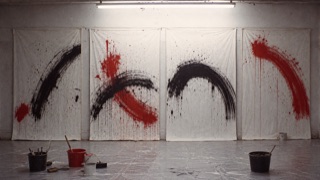
A postwar Austrian movement that expanded painterly gesture into ritualized actions with bodies, liquid, cloth, organic matter, photography, and film; repeated lines, splashes, binding, and documentation form its visual core.
| Action Painting | Viennese Actionism | |
|---|---|---|
| Era | late 1940s–1960s | 1960s–early 1970s |
| Family | Postwar American Art | Modern and Contemporary Art Movements |
| Kind | Style | Style |
| Cues | Drips, splashes, and runs retaining gravity / Long strokes that reveal the reach of an arm or body / Layers, scraping, and repainting left visible / Density and open intervals distributed without a central figure | Black or red liquid against a white body or cloth / Bodies divided by bandage, rope, and geometric line / Grainy frontal photographic or film documentation / Ritual repetition and extreme bodily action |
| Best used for | Making bodily speed and hesitation visible as traces rather than finished geometry · Building an abstract stage, motion, or campaign field around one physical gesture | Presenting 1960s body-based performance history together with its recording media · Comparing how painting moved from object into ritual, action, and duration |
| Type | Add small type after painting; do not substitute a brush-script font for physical motion. | Keep neutral record information separate from the action and avoid sensational headlines. |
| Composition | Work on a floor or large wall without fixing the center first, alternating the body's reach with intervals of rest. | Document the whole body, material contact, and chronology from a fixed viewpoint. |
| Material | Use paints of different viscosities, broad brushes, sticks, and pouring tools; include drying time and gravity in the process. | For contemporary interpretation, design safe substitutes, consent, hygiene, and exit conditions; do not reenact dangerous originals. |
| Caution | A uniform splatter brush produces background texture without bodily sequence or weight. Protect the room and people, and verify ventilation and material safety. | Do not imitate shock images or intervene on bodies without consent. Treat this as difficult history and address injury, animal welfare, law, and trauma. |
Postwar American Art / Modern and Contemporary Art Movements